Managing digital content across multiple platforms is a major challenge for universities. A headless CMS solves this by separating content creation from its display, enabling centralized updates that work seamlessly across websites, apps, and more. This approach saves time, ensures consistent branding, and meets modern students' expectations for personalized, mobile-friendly experiences.
Key benefits of a headless CMS in higher education include:
- Centralized content management: Update information once and publish it across all platforms.
- Multi-channel delivery: Support websites, apps, digital signage, and even AR/VR.
- Improved collaboration: Role-based access allows departments to manage their content independently.
- Personalized student experiences: Tailored content powered by real-time data integration.
- Scalability: Handles high-traffic periods like admissions deadlines without crashing.
Real-world examples include universities like VU Amsterdam and the University of Idaho, which streamlined operations, reduced publishing delays, and improved student engagement by adopting headless CMS platforms like Kontent.ai and Drupal.
This approach modernizes how institutions manage and deliver content, making it easier to meet the demands of today’s tech-savvy students while maintaining operational efficiency.
Headless CMS: Your Questions Answered
sbb-itb-94eacf4
Content Management Challenges in Higher Education
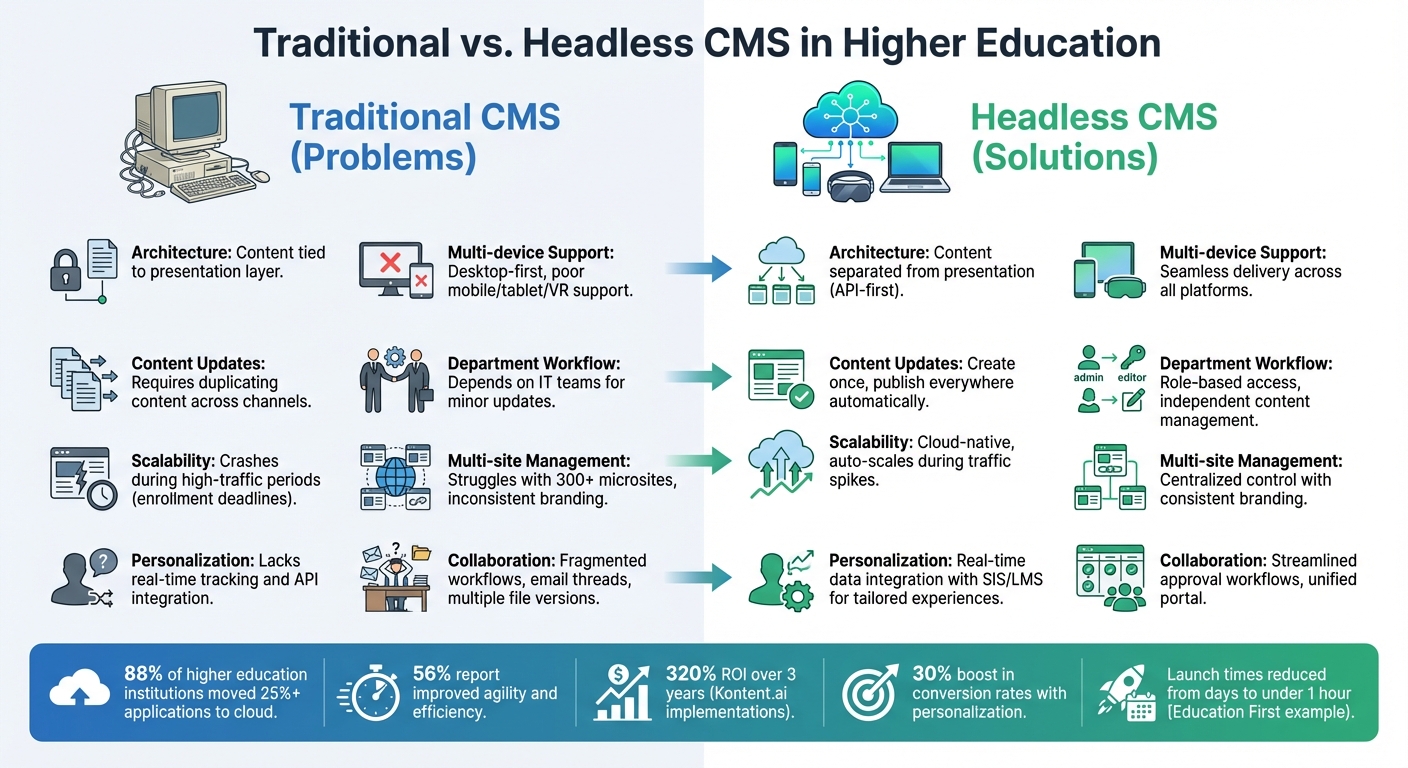
Traditional CMS vs Headless CMS in Higher Education: Key Differences
Universities are under growing pressure to upgrade their digital systems, yet many still rely on outdated platforms that simply can't meet the demands of today’s always-connected, multi-device student population. These legacy systems slow down publishing, complicate coordination between departments, and limit students' access to critical information. This creates an urgent need to explore how headless CMS solutions can address these issues.
Outdated CMS Technology
Traditional content management systems were created for a desktop-first world, which makes them ill-suited for the diverse devices students use today - smartphones, tablets, smart TVs, and even VR headsets. These older platforms often tie content creation directly to its presentation, making it difficult to deliver consistent user experiences across multiple channels. For instance, updating a faculty profile or course description for a mobile app may require duplicating the same information already posted on the main website - a time-consuming and inefficient process.
This technical rigidity creates significant bottlenecks. Non-technical staff in departments like admissions or athletics frequently depend on IT teams for even minor updates, slowing down workflows. Large universities, some managing over 300 microsites for their departments and research centers, struggle to maintain consistent branding because these systems weren’t built for multi-site coordination. Additionally, during high-traffic times like enrollment periods, these platforms often buckle under the pressure, causing slow load times that frustrate prospective students. These challenges highlight the need for modern, decoupled systems that can handle real-time updates across multiple channels.
Poor Cross-Department Collaboration
Universities often face disjointed content workflows due to decentralized departments working in silos. Without integrated approval processes, teams rely on outdated methods like juggling multiple file versions and long email threads to coordinate updates. For example, before May 2025, the University of Idaho’s communications team dealt with fragmented content and inconsistent branding across their departmental sites. By switching to a decoupled Drupal CMS, they streamlined their content management, unified branding across more than 300 microsites, and reduced publishing delays.
"Most 'headless CMS' vendors still tell a developer‑centric story. That's great for APIs - but not enough for institutions that need orchestration, governance, and empowering non‑technical content authors across campus."
– Joel Varty, CTO, Agility CMS
These inefficiencies go beyond workflows - they also make it harder to deliver the personalized experiences students now demand.
Limited Student Personalization
Today’s students, especially Gen Z, expect personalized interactions similar to what they experience on platforms like Netflix or Amazon. They want tailored recommendations, relevant notifications, and content that adapts to their unique needs. Unfortunately, traditional CMS platforms lack the real-time tracking and API-first design needed to deliver dynamic, personalized content across multiple devices. As a result, students often find themselves overwhelmed trying to navigate fragmented departmental websites and portals.
Personalization isn’t just a "nice-to-have" - it’s a game-changer. Organizations that fully embrace personalization can boost conversion rates by up to 30%. Additionally, around 80% of modern consumers (including prospective students) say that the overall experience an organization provides is just as important as its actual services. Legacy systems, however, struggle to integrate with tools like Student Information Systems (SIS) or Learning Management Systems (LMS), which are crucial for pulling real-time data. This means they can't deliver features like custom course recommendations based on a student’s major or targeted event alerts based on their location on campus. In contrast, modern headless CMS platforms are designed to support the dynamic personalization that today’s students expect.
How Headless CMS Benefits Higher Education
Headless CMS platforms tackle the challenges of traditional systems by separating content from its presentation layer. This setup gives universities the freedom to create content once and share it across multiple platforms - websites, mobile apps, digital kiosks, and even VR headsets - without needing to update each channel individually.
Multi-Channel Content Delivery
With the "create once, publish everywhere" model, content management becomes far more efficient for universities. When a department updates key information, that update automatically reflects across the main university website, departmental microsites, student portals, and mobile apps. This streamlined process eliminates repetitive tasks and saves time.
"A headless CMS allows educational institutions to deliver content seamlessly across various channels - websites, mobile apps, digital signage, online video, and virtual classrooms."
– Sara Williams, Content Creator, CrafterCMS
Take Education First (EF) as an example. After adopting the Storyblok headless CMS in May 2025, they transformed how they managed multilingual learning materials across global markets. Regional editors gained the ability to localize and publish content without developer assistance. Launch times, which previously took several days, dropped to under an hour, and the user experience improved across web, mobile, and kiosks. Similarly, The University of Melbourne used Sanity.io to modernize its course catalog. By leveraging structured content models, they seamlessly pushed updates to student portals, mobile apps, and scheduling tools.
Team Collaboration and Access Control
Headless CMS platforms offer role-based access control, allowing departments to manage their own content areas securely. For instance, admissions teams can update application deadlines, athletics departments can post game schedules, and faculty members can maintain their profiles - all without interfering with the overall site. This setup also frees developers to focus on enhancing the front-end experience while content teams work independently.
Despite this decentralization, administrators maintain control over branding and governance. For example, CloudCannon provides SOC 2 Type 2 certification and integrates SAML and SSO authentication to ensure secure permissions management. Large institutions like the University of Idaho have leveraged these features to maintain consistent branding across more than 300 departmental microsites after switching to a decoupled Drupal CMS in May 2025. These collaboration tools make it easier to handle complex operations while keeping everything aligned.
Handling Traffic Spikes and Global Operations
Cloud-native headless CMS platforms are built to handle high-traffic periods, such as admissions deadlines or major events, by scaling automatically. Unlike older systems that might crash under pressure, these platforms distribute the load efficiently, ensuring smooth performance when prospective students need access the most.
For universities with international campuses or satellite locations, a headless CMS offers centralized management while allowing regional flexibility. Harvard Business School Online implemented a custom headless architecture with a React front-end in May 2025. This system supports tens of thousands of learners globally, enabling modular course creation and seamless API integration with their Learning Management System and analytics tools. The platform also manages time zones, languages, and regional content from a single interface, empowering local editors to handle multilingual materials without technical delays.
Key Applications of Headless CMS in Higher Education
Universities are increasingly adopting headless CMS platforms to reshape essential academic services. These systems support everything from tailored student portals to comprehensive research databases, addressing limitations often found in traditional systems.
Personalized Student Portals
Headless CMS platforms enable the creation of dynamic student portals powered by real-time data. By integrating with Student Information Systems (SIS) and ERPs through APIs, these portals provide personalized features like course suggestions, deadline alerts, and event notifications. The information is tailored to each student's major, academic progress, and interaction history, ensuring they get timely updates on their preferred devices.
For instance, organizations using Kontent.ai for such implementations reported an impressive 320% ROI over three years.
Multilingual Campuses and eLearning Integration
For universities catering to diverse student populations, headless CMS simplifies the management of multilingual content and eLearning resources. Acting as a centralized hub, it allows regional editors to independently handle translations and localized materials. Advanced features like automated locale-based routing (e.g., /en/, /de/, /latam/) and side-by-side translation tools streamline the publishing process.
A great example is the University of Amsterdam, which consolidated over 30 separate websites into a unified portal serving 41,000 students and 6,000 staff members. Similarly, Education First (EF) utilized Storyblok to empower regional editors to localize and publish content without developer support. These platforms also integrate seamlessly with Learning Management Systems (LMS), pulling in course details and instructor information for public-facing sites while leaving enrollment and certifications to the LMS.
Event Management and Research Portals
Headless CMS platforms revolutionize event management and research publishing. For events, they act as a central hub for details like speaker bios, schedules, and venue information. Any updates - such as rescheduled sessions or canceled speakers - are instantly reflected across websites, mobile apps, and digital signage. Integration with registration and payment systems further enhances the attendee experience.
Research portals also gain significant advantages. Structured content modeling connects faculty profiles with their publications, research groups, and projects. For instance, the University of Idaho adopted a decoupled Drupal CMS in May 2025 to manage over 300 microsites, integrating event tools and directories while maintaining consistent branding. Similarly, the University of Melbourne used Sanity.io to modernize its course catalog, enabling real-time collaboration between academic and content teams and improving discoverability across platforms. Role-based access control ensures research departments can manage their content independently, while administrators maintain oversight of branding and governance.
These use cases highlight the transformative potential of headless CMS in higher education, paving the way for more strategic implementations.
Implementation Strategies for Higher Education Institutions
Switching to a headless CMS requires careful consideration of costs, security measures, and advancing technology. For universities, this shift comes at a time of financial strain. Undergraduate enrollment dropped 15% between 2010 and 2021, and experts expect another 15% decline in high school graduates by 2039. With these challenges, selecting the right implementation strategy is more important than ever. Below, we explore key approaches and tech integrations to help institutions navigate these obstacles effectively.
SaaS vs. Self-Hosted Solutions
Choosing between SaaS and self-hosted headless CMS options is a pivotal decision, and it largely depends on budget constraints and IT capabilities. SaaS platforms operate on subscription models, covering hosting, updates, and support. On the other hand, self-hosted solutions require significant upfront investments in hardware, licenses, and ongoing costs like IT staffing and maintenance.
"SaaS eliminates expensive on-premise infrastructure and reduces IT maintenance." - Modern Campus
A growing number of institutions are embracing cloud-based solutions. In fact, 88% of higher education institutions have moved at least 25% of their applications to the cloud, with 56% reporting improved agility and efficiency. SaaS platforms are particularly advantageous during high-traffic periods, such as enrollment deadlines, as they scale automatically to meet demand.
When comparing options, conducting a thorough Total Cost of Ownership (TCO) analysis is crucial. This should include hidden costs like data center cooling and IT staffing. Additionally, ensure the SaaS provider offers tools for data portability to avoid vendor lock-in.
Security and Compliance Requirements
A headless CMS reduces security risks by separating the public-facing application from the backend. Content is delivered through secure APIs, minimizing exposure to potential attacks. This setup is especially important for protecting sensitive student data under FERPA and GDPR regulations. A secure, compliant system also ensures a reliable multi-channel experience.
When selecting a CMS, prioritize vendors that support compliance standards like ADA, Section 508, and international privacy laws. Role-Based Access Control (RBAC) is another essential feature, as it limits access to specific content areas based on departmental roles. Additionally, approval workflows can prevent unauthorized or non-compliant updates from going live. Before migrating to a headless CMS, assess your existing infrastructure to confirm compatibility with legacy systems like Student Information Systems and Learning Management Systems.
Integrating AI, AR/VR, and Emerging Technologies
Modern CMS platforms not only secure data but also enable institutions to adopt cutting-edge technologies. A headless CMS, built on an API-first approach, allows seamless integration of tools like AI, AR/VR, and other innovations without requiring a complete digital overhaul.
For example, AI can enhance student experiences through chatbots, personalized course recommendations, and adaptive learning paths. These updates can be managed directly through the CMS, even by non-technical staff. Meanwhile, AR and VR technologies are gaining traction. The AR/VR sector was projected to reach $300 billion by 2024, with the global VR market estimated at $48.5 billion by 2025. By storing 3D models and interactive assets in the CMS, institutions can reuse them across devices like VR headsets, AR-enabled phones, and smartboards.
To start, consider piloting a single feature, such as a virtual campus tour, before scaling up. AI-powered CMS tools can also streamline tasks like image tagging, SEO optimization, and content translation, boosting efficiency. However, ensure your network infrastructure can handle the bandwidth demands of these advanced technologies and applications.
Conclusion
Higher education faces the dual challenge of declining enrollment and tighter budgets, all while needing to meet modern students' expectations for seamless digital experiences. A headless CMS offers a solution by separating content management from its presentation, allowing universities to publish content once and distribute it effortlessly across websites, mobile apps, portals, and even emerging platforms like AR/VR devices.
Schools that have adopted headless CMS solutions report faster response times and more cohesive digital experiences. For example, Education First and the University of Idaho have seen significant improvements in launch speeds and streamlined content management. These advancements result in smoother, more personalized experiences for students accustomed to the speed and convenience of modern digital platforms.
"This isn't just 'headless.' It's content orchestration for the modern digital campus." - Joel Varty, CTO, Agility CMS
With its API-first design, a headless CMS ensures institutions aren’t tied to outdated technology. This flexibility eliminates vendor lock-in and supports seamless integration with tools like AI chatbots, adaptive learning systems, and immersive technologies as they evolve. By adopting this approach, universities not only prepare for future technological shifts but also enhance their ability to engage students right now.
FAQs
What’s the quickest way to pilot a headless CMS on a university campus?
When introducing a headless CMS on campus, the best strategy is to start with an incremental deployment. Begin with a small-scale rollout, gradually adding features and custom tools to ensure the transition is manageable. Opting for cloud-based headless CMS platforms with scalable, easy-to-use options can streamline both setup and content management across various sites. This step-by-step approach helps teams experiment, make adjustments, and expand effectively while keeping disruptions to a minimum.
How does a headless CMS connect to SIS and LMS tools for personalization?
A headless CMS connects with Student Information Systems (SIS) and Learning Management Systems (LMS) through APIs, allowing real-time data exchange. This means the CMS can access student details like enrollment status and preferences to deliver personalized content across different platforms. By centralizing this data, it enables tailored learning paths, more precise communication, and customized user interfaces, improving student engagement and overall digital interactions.
What security and FERPA/GDPR controls should a headless CMS include?
When choosing a headless CMS, enterprise-level security is a must-have. This means it should include features like:
- Data encryption: Protocols such as SSL/TLS and AES safeguard information during transmission and storage.
- Access controls: Strong authentication and role-based permissions help ensure that only authorized users can access sensitive data.
- Regulatory compliance: Adherence to standards like FERPA and GDPR ensures that privacy requirements are met, particularly when handling sensitive student information.
These measures are critical for protecting data and maintaining trust, especially in environments where privacy is a top priority.