Want to increase clicks, engagement, and conversions? Start with your headlines. Research shows 8 out of 10 people read headlines, but only 2 out of 10 continue to the content. A strong headline grabs attention, builds trust, and drives action. Here's what works:
- Clarity, relevance, and specificity: Make your headline clear, match reader intent, and include concrete details (like numbers).
- Psychological triggers: Use curiosity, emotion, and urgency to hook readers. For example, curiosity-driven headlines can boost traffic by up to 500%.
- Proven formulas: Number-based headlines (“7 Ways to Improve X”), problem-solution headlines (“Stop Making These 5 Mistakes”), and question/command headlines are highly effective.
- Testing and optimization: A/B test headlines to see what resonates. Metrics like click-through rate (CTR) and conversion rate reveal what works.
Crafting a headline is more science than art. Use these strategies and tools like CoSchedule or OptinMonster to refine your approach and drive real results.
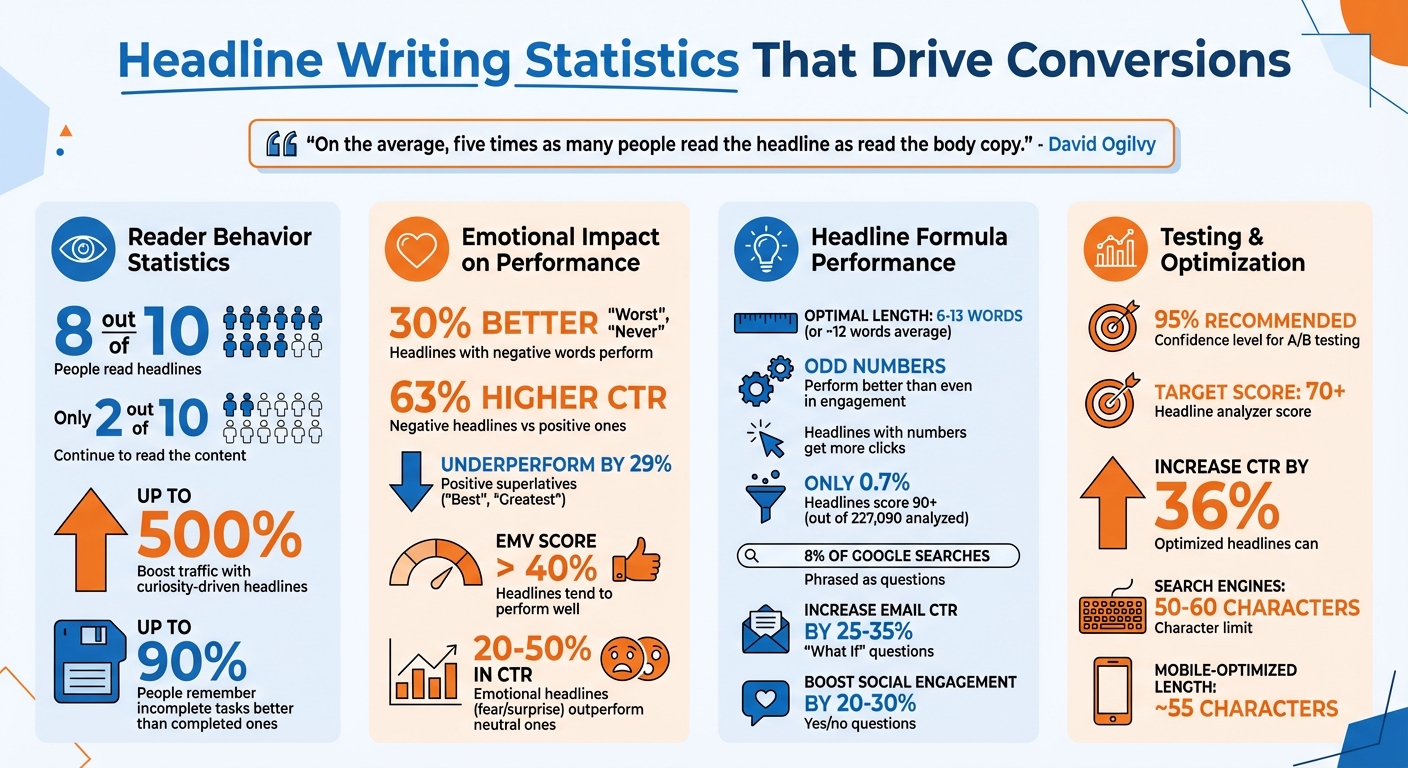
Headline Writing Statistics and Performance Metrics
How to Create High-Converting Headlines!
sbb-itb-94eacf4
Psychology Behind Effective Headlines
Headlines work because they align with how our brains naturally function. The human brain constantly scans for threats, rewards, and gaps in knowledge. By crafting headlines that match these tendencies, you can grab attention and spark engagement.
Using Curiosity to Drive Clicks
Curiosity is more than just wanting to know something - it’s a biological response. When there’s a gap between what we know and what we want to know, it creates a sense of discomfort. Behavioral economist George Loewenstein explains this as:
"Curiosity is not merely a desire for information, but an aversive state, a deprivation that we are motivated to eliminate".
This is called the Information-Gap Theory. When a headline leaves just enough mystery, it triggers a dopamine response, making readers eager to fill in the blanks. In fact, curiosity-driven headlines can generate up to 500% more traffic compared to straightforward ones. However, the trick lies in balance - too vague, and no one clicks; too detailed, and there’s no reason to explore further.
A great example of this is how people remember incomplete tasks better than completed ones - by up to 90%. As Joseph Sugarman, author of The Adweek Copywriting Handbook, famously said:
"The sole purpose of the headline is to get you to read the first sentence".
By creating an open loop, curiosity hooks the reader. But curiosity alone isn’t enough - emotion deepens the connection.
Connecting Through Emotion
Curiosity grabs attention, but emotion keeps it. While logic helps justify decisions, emotions are what truly drive them. Headlines that resonate emotionally - whether by addressing fears, desires, or struggles - create an immediate connection.
Interestingly, negative emotions can be especially effective. Headlines using words like "worst" or "never" tend to perform 30% better and have a 63% higher click-through rate compared to positive ones. This taps into loss aversion, the idea that people feel the pain of losing twice as strongly as the joy of gaining. For instance, a headline like "Stop Making These 5 SEO Mistakes" feels more urgent than "The 5 Best SEO Tactics."
On the flip side, positive superlatives such as "best" or "greatest" often underperform by 29% compared to neutral phrasing. Headlines scoring above 40% on the Emotional Marketing Value (EMV) scale tend to do well. As Courtney Seiter, former Director of People at Buffer, points out:
"The brain's pleasure centers are more turned on when we experience unpredictable pleasant things, compared to expected pleasant events".
Emotion and curiosity work well together, but urgency adds another layer of motivation.
Creating Urgency and Scarcity
Urgency pushes readers to act now by introducing time-sensitive stakes. It works by creating a mild sense of anxiety that motivates immediate action. Our brains are wired to prioritize potential threats over opportunities. When a headline hints at a problem or risk, it triggers a need to learn more. Ronn Torossian, Chairman & Founder of 5WPR, explains:
"The brain essentially says: 'I need to know about this potential threat right now'".
Adding specific timeframes - like "in 14 days", "this week", or "before you launch" - makes the urgency more concrete. Scarcity amplifies this effect. Words like "limited", "only", or "last chance" create a fear of missing out (FOMO), making readers feel they need to act quickly. Headlines that evoke emotions such as fear or surprise can outperform neutral ones by 20–50% in click-through rates.
However, urgency must be used responsibly. If you create anxiety or scarcity without delivering real value, you risk losing trust. The goal is to highlight a genuine problem and show readers that your content provides the solution. Done ethically, urgency can be a powerful way to engage your audience and encourage action.
Headline Formulas That Drive Conversions
Understanding the psychology behind headlines is one thing - putting it into practice is another. Luckily, you don’t have to start from scratch every time. Tried-and-tested formulas exist that consistently grab attention and drive action. These templates work because they tap into core psychological triggers like curiosity, emotion, and urgency. The trick is knowing which formula aligns with your goals and audience. Let’s take a closer look at the formulas that deliver results.
Number-Based Headlines
Numbers have a unique way of grabbing attention. When people skim through content, numbers stand out visually, signaling that the information is organized and easy to digest. This makes them a powerful tool for headlines.
Numbers also set clear expectations. A headline like "7 Simple Ways to Double Your Engagement" tells readers exactly what they’ll get and how much effort it will require. The formula - [Number] + [Adjective] + [Noun] + [Promise] - is a staple in copywriting for a reason. It provides structure and clarity, which builds trust.
Interestingly, odd numbers tend to perform better than even ones when it comes to engagement. Studies also show that headlines with 6–13 words get the most clicks, and using specific numbers (like "27% improvement") adds credibility. HubSpot’s most shared posts often feature numbers in their headlines, proving this approach works across various industries.
For example, compare these two headlines: "Ways to Grow Your Followers" versus "7 Ways to Grow Your Followers." The second is more specific and actionable. You can also combine numbers with outcomes and objections for even more impact, such as "5 Ways to [Outcome] Even If [Objection]".
Problem-Solution Headlines
Problem-solution headlines are highly effective because they address a reader’s pain point and promise a fix. This approach works especially well for landing pages and lead generation, where the goal is to connect with someone already aware of their problem.
A strong variation of this is the "Without" formula: "Get [Benefit] Without [Frustration]". For instance, "Automate Your Invoicing Without Hiring a Bookkeeper" tackles the goal of automation while addressing concerns about cost or complexity.
Relief is a powerful motivator. Headlines that promise to solve frustrations tap into the brain’s natural drive to avoid pain. As Barbara Bartucz from OptiMonk explains:
"Your headline is more than copy; it's your first and most powerful conversion lever".
Formulas like "Get [Benefit] Without [Frustration]" or negative phrasing with words like "Stop" or "Avoid" can be especially compelling. For example, "5 SEO Mistakes Killing Your Search Rankings" is more attention-grabbing than "5 SEO Tips to Improve Your Rankings" because it triggers loss aversion and prompts immediate action.
Adding specificity enhances these headlines even further. Instead of "Fix Your Website’s Bounce Rate," try "Fix Your Website’s Bounce Rate in 30 Days."
Question and Command Headlines
Questions and commands take different paths but are both highly effective when used strategically. Question headlines create a curiosity gap - the space between what the reader knows and what they want to know. They’re particularly useful for SEO because they often align with the exact queries people type into search engines. In fact, about 8% of all Google searches are phrased as questions.
A good question headline either mirrors what the reader is already wondering or sparks curiosity. For instance, "Is Your Website Losing Visitors?" addresses a common concern and invites exploration. "What If" questions can increase email click-through rates by 25–35%, while yes/no questions on social media can boost engagement by 20–30%.
Focus on questions that matter. Skip generic ones like "Want to Grow Your Business?" and opt for something specific, like "Want a Happy Marriage? Science Says Look for These Personality Traits."
Command headlines, on the other hand, use strong action verbs to push readers toward a goal. They’re clear, direct, and often create urgency. These work best for audiences already aware of their problem and ready to act. Examples include "Start Boosting Conversions Today" or "Stop Wasting Money on Ads That Don’t Work."
For maximum impact, lead with the benefit, especially for mobile readers. A headline like "Double Your Traffic in 14 Days" is far more compelling than "Learn How to Double Your Traffic" because it’s straightforward about the outcome.
Daniel Kempe from Supawrite captures it perfectly:
"The difference between a headline that flops and one that delivers qualified leads isn't luck - it's science".
Whether you’re using numbers, problem-solution framing, questions, or commands, the key is matching the formula to your audience’s mindset and the action you want them to take. Each formula has its strengths, and knowing when to use which one can turn a good headline into a great one.
Testing and Optimizing Your Headlines
Understanding headline formulas is helpful, but testing is the only way to determine what resonates with your audience. A/B testing, or split testing, involves showing one version (the control) to half of your audience and a different version (the challenger) to the other half. This approach helps identify which headline performs better. To get accurate results, focus on changing just one element at a time - like the headline itself. If you tweak multiple elements, such as the headline and a button color, you won't know which change impacted the outcome.
David Ogilvy once said:
"On the average, five times as many people read the headline as read the body copy. When you have written your headline, you have spent eighty cents out of your dollar".
This shows why even small improvements in your headline can lead to big changes in performance.
How to Run A/B Tests on Headlines
Start by brainstorming different headline variations that tap into psychological triggers like numbers, curiosity, or pain points. Decide on a key metric to measure success - whether that's click-through rate (CTR), conversions, or sign-ups. This ensures your analysis stays focused and unbiased.
Run both headline versions at the same time to avoid external factors, like time of day or seasonal trends, from skewing results. Use a sample size calculator to ensure enough participants for reliable data - small samples can give misleading results. Most marketers aim for a 95% confidence level to confirm statistical significance.
Matt Rheault, Senior Software Engineer at HubSpot, explains:
"The more radical the change, the less scientific we need to be process-wise. The more specific the change (button color, microcopy, etc.), the more scientific we should be because the change is less likely to have a large and noticeable impact on conversion rate".
Let the test run until you gather enough data to draw meaningful conclusions. Once the test is live, keep an eye on key performance metrics to evaluate success.
Tracking Performance Metrics
Metrics are essential for understanding how your headlines perform. Here are the key ones to focus on:
- Click-through rate (CTR): This measures the percentage of users who click on your headline compared to total impressions. It's a strong indicator of whether your headline grabs attention.
- Bounce rate: A high bounce rate often means your headline doesn't match the content, leaving visitors disappointed or misled.
- Conversion rate: This tracks the percentage of users who take the desired action after clicking. It's the ultimate measure of whether your headline achieves your business goals.
Meghan Carreau, Co-Founder & Executive UX Design Officer at Aztech, advises:
"Typically, you need to get to statistical significance... I typically start reporting after two weeks, but it depends on the brand and the site traffic".
| Metric | What It Measures | Why It Matters for Headlines |
|---|---|---|
| Click-Through Rate (CTR) | % of users who click the headline | Shows if the headline captures attention |
| Bounce Rate | % of users who leave after one page | Indicates if the headline matches the content |
| Conversion Rate | % of users who complete desired action | Proves if the headline drives your goal |
| Scroll Depth | How far down the page users travel | Reveals if the headline engages the right audience |
To dig deeper, segment your results by behavior or demographics. This can uncover trends specific to certain audience groups. Tools like heatmaps can also help visualize where users drop off after interacting with your headline.
Refining Headlines Based on Data
Use the insights from your tests to refine your headline strategies. When a winner emerges, update your live site with the better-performing headline to maximize conversions. While CTR and social shares are helpful, focus on conversion rates to measure true success.
Experiment with specific variables to see what drives results. For example, test headlines with different lengths or those that emphasize numbers, curiosity, or pain points. Writing at least 50 headline variations increases your chances of finding one that truly stands out. If your site has low traffic, headline analysis tools can provide data-driven predictions about audience reactions.
Joanna Wiebe, Founder of Copyhackers, highlights five key criteria for a strong headline:
"A powerful headline will meet these five criteria: Matches visitor expectations; Grabs the visitor's attention; Is clearly communicated; Gets to the point; Highlights something beneficial".
Use these guidelines as a framework when refining your headlines. Beyond just headlines, apply similar A/B testing techniques to other elements like calls to action, images, or page layouts to drive even better results.
Tools and Resources for Writing Better Headlines
Crafting headlines that grab attention and drive engagement doesn't have to be a guessing game. By using tools designed to analyze and optimize headlines, you can turn it into a data-driven process. These tools help you refine your wording, test variations, and ensure your headlines resonate with your audience.
Top Website Builders for Headline Testing
If you're running a website, consider using platforms that support A/B testing. This method lets you compare different headline versions to see which performs better in terms of clicks, sign-ups, or sales. Websites like Top Website Builders can guide you in finding tools that offer helpful metrics like engagement scores and readability ratings.
For newer or low-traffic sites, headline analyzers available through Top Website Builders rely on linguistic patterns and historical data to predict performance. On high-traffic sites, A/B testing remains the gold standard, as it uses real-time data from your audience. Many of these tools also assess SEO, tone, and sentiment, ensuring your headlines align with what your visitors are looking for.
Once you’ve chosen a platform, you can further improve your headlines by using specialized analysis tools.
Headline Analysis and Testing Tools
After setting up your website for testing, take it a step further with headline analysis tools. These platforms provide immediate feedback and scoring to help you create more effective headlines:
- CoSchedule Headline Studio: This tool offers a "Headline Score" based on factors like SEO, word balance, and sentiment. It also includes analyzers tailored for platforms like YouTube, TikTok, Instagram, and email subject lines. Available as a free version or WordPress plugin, it flags headlines that exceed the 50–60 character limit typically shown by search engines.
- OptinMonster Headline Analyzer: This free tool scores headlines on a scale of 1–100, focusing on emotional appeal and character length to improve click-through rates. It even provides a Google Search preview so you can see how your headline will appear in search results. Aim for a score of 70 or higher for optimal performance.
"For example, in a seven‐month period ending in 2014, Michael Stelzner, founder of Social Media Examiner, added 95,654 names to his email list by utilizing OptinMonster's headline‐driven Exit Intent technology".
- HeadlineBoost: Using AI trained on over 1 million headlines, this tool provides instant scores for click-through rates (CTR), SEO, and readability. It allows up to five free analyses per day without requiring sign-up and offers additional suggestions through API integration. According to HeadlineBoost research, optimized headlines can increase CTR by 36%, with headlines containing numbers performing particularly well.
To get the most out of these tools, draft 3–5 headline variations - or even more, as some experts suggest - to uncover the most effective option. By combining these tools with consistent testing, you can ensure your headlines are optimized to drive results.
Conclusion
Summary of Headline Writing Strategies
Creating headlines that grab attention and drive action is no small feat. The best headlines communicate their value in just two seconds, using clear, benefit-focused language and specifics like numbers or timeframes. To really hook readers, lead with strong action verbs and front-load the benefits. Research shows that the most effective headlines are typically about 12 words long.
Emotion and action are key drivers of clicks. Words that evoke feelings or inspire action can make all the difference, while positive framing tends to boost engagement. A study of 227,090 headlines revealed that only 0.7% earned a performance score of 90 or above. This highlights how challenging it can be to craft a standout headline. Often, success lies in strategic word placement - readers tend to focus on the first and last three words of a headline, so make those count. By applying these strategies, you can consistently refine your headline-writing skills.
How to Improve Your Headlines Going Forward
When brainstorming headlines, aim for quantity - generate 10 to 20 variations to explore different angles and avoid settling too quickly. Then, evaluate each option for simplicity, brevity, and specificity. For mobile users, keeping headlines around 55 characters ensures clarity.
Take inspiration from Leo Burnett's timeless advice:
"Make it simple. Make it memorable. Make it inviting to look at. Make it fun to read".
Use the headline formulas and testing methods discussed earlier to refine your work. A/B testing is a great way to see what resonates - try it with email subject lines, social media posts, or landing page creators. Leverage analysis tools to aim for scores of 70 or higher. Remember, feedback from real users is far more valuable than guesswork, so make testing and tweaking an ongoing part of your process.
FAQs
How do I write a headline that’s not clickbait?
To steer clear of writing clickbait headlines, prioritize clarity, relevance, and honesty. A good headline should be straightforward, precise, and clearly convey the value of the content to the reader. Skip the over-the-top claims or ambiguous promises. Instead, focus on emphasizing the main benefit or result the reader can expect, using active wording and specific details. This way, you establish trust while keeping your headline engaging and truthful.
What’s the best headline formula for my goal?
The most effective headline formulas focus on three key elements: clarity, benefit, and curiosity. Some tried-and-true methods include incorporating numbers, being specific, and using value-packed phrases like "How to [achieve X] in [Y]" or "[Number] ways to [benefit]". Headlines that fall within the 6–13 word range often grab attention while maintaining relevance. Keep your language concise and centered on the reader's benefits to boost engagement.
How long should I A/B test a headline?
The general guideline for running an A/B test on a headline is about two weeks. This period usually provides enough time to gather meaningful data. That said, the exact duration can depend on factors like your audience size and the amount of website traffic you receive. For most scenarios, two weeks is a solid timeframe to achieve reliable, statistically significant results.

