Real-time personalization uses live user behavior to create tailored digital experiences instantly. This approach, unlike relying on past data, focuses on what users are doing in the moment - such as clicks, navigation paths, or hesitation signals. Why does this matter?
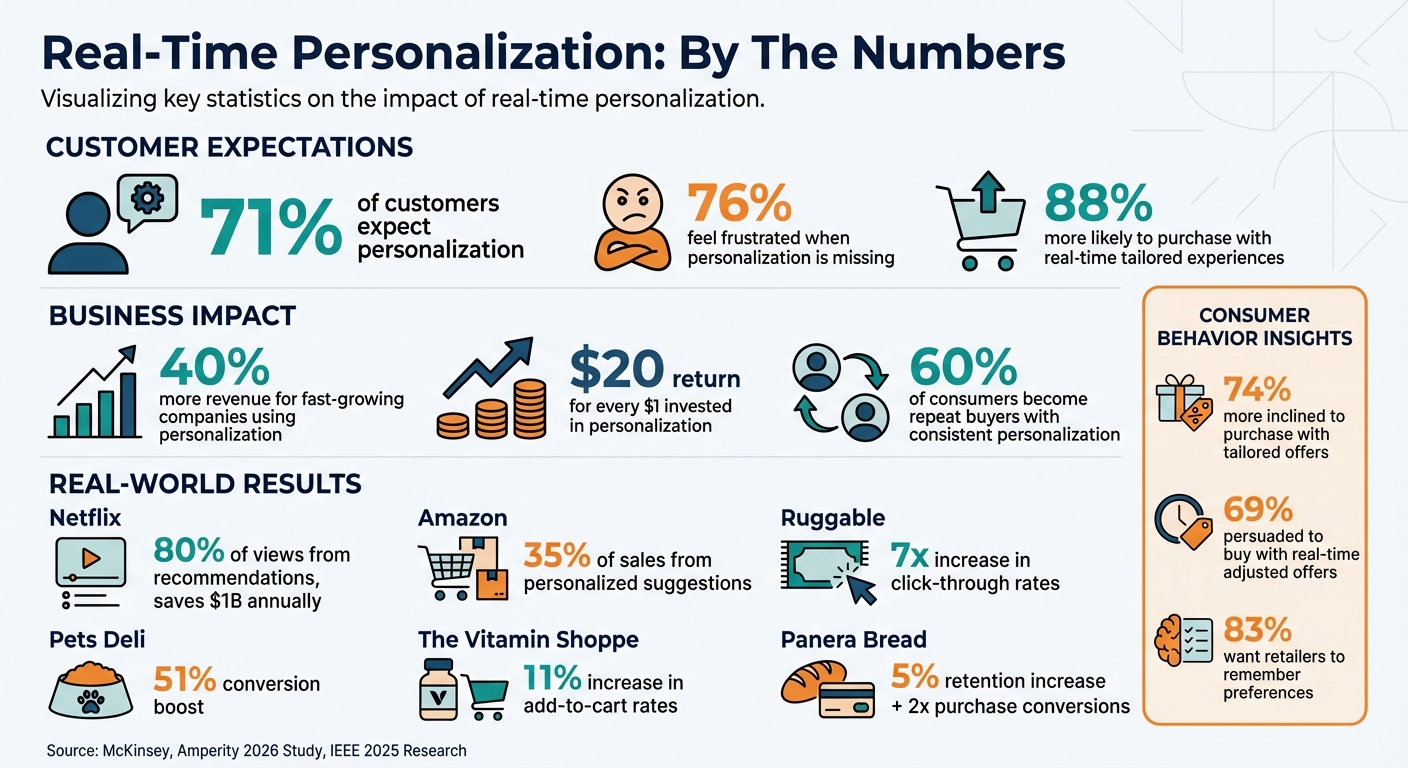
- 71% of customers expect personalization, and 76% feel frustrated when it’s missing.
- Businesses leveraging this strategy see up to 40% more revenue than slower adopters.
- Real-time adjustments, like offering free shipping when users linger on checkout pages, boost conversions significantly.
Examples in action:
- Ruggable: A 7x increase in click-through rates by updating pages dynamically.
- Pets Deli: A 51% conversion boost through tailored promotions.
- Netflix: Personalized recommendations drive over 80% of views, reducing churn.
- Amazon: Real-time suggestions account for 35% of sales.
This method requires fast systems, processing data in milliseconds to meet fleeting user intent. Challenges include high infrastructure costs and complex implementation, but the payoff in loyalty and revenue makes it a priority for modern businesses using no-code ecommerce website builders.
Real-Time Personalization Impact: Key Statistics and ROI Data
Research Findings on Behavioral Data and Personalization
Effects on Engagement and Retention
According to McKinsey research, companies experiencing rapid growth generate 40% more revenue from personalization efforts compared to their slower-growing competitors. This advantage is tied to lasting behavioral shifts: 60% of consumers are more likely to become repeat buyers when brands deliver consistent, personalized experiences.
The 2026 State of Personalization in Retail study by Amperity, which surveyed 1,000 U.S. consumers, revealed that 74% of shoppers are more inclined to make a purchase when they receive tailored offers or recommendations. Additionally, 69% of shoppers are persuaded to buy when offers are adjusted in real time while they browse.
"Consumers aren't asking for more messages - they're asking for relevance in the moment. This research makes it clear that real-time personalization is now one of the most direct paths to revenue growth." - Tony Owens, CEO, Amperity
Personalization doesn’t stop at offers. A striking 83% of consumers want retailers to remember their preferences and past purchases. By integrating historical data with real-time behavior, brands can deliver content that feels both familiar and timely, fostering deeper loyalty. For instance, a 2025 IEEE study on predictive clickstream analytics found that machine learning-based content updates significantly improved engagement metrics like click-through rates, session duration, and user satisfaction compared to static delivery methods. These enhanced metrics not only strengthen loyalty but also contribute to better conversion outcomes.
Conversion Rate Improvements
Personalization also has a direct impact on conversions. In 2025, The Vitamin Shoppe leveraged Bloomreach's real-time recommendation engine to personalize category pages. By delivering tailored suggestions within 0.1 seconds of user actions, they achieved an 11% increase in add-to-cart rates. Similarly, baby-walz tailored email campaigns to a customer’s pregnancy stage and baby’s gender, resulting in a 53.8% boost in average open rates.
The financial benefits of personalization are hard to ignore. Research shows that for every dollar invested in these techniques, businesses can see returns as high as $20. For example, in 2020, Walmart implemented a real-time framework for their online grocery homepage. By dynamically ranking item carousels based on live user behavior, they enhanced item discovery, increased engagement, and saw a noticeable lift in add-to-cart rates per visitor.
Retailers using context-aware personalization also see impressive results. In 2025, interior decor retailer bimago replaced traditional A/B testing with AI-driven contextual personalization for subscription banners. This approach led to a 44% increase in conversion rates.
"Retailers that unify identity, historical data, and live behavioral signals can close that gap and turn personalization into measurable business impact." - Ornella Urso, Research Director at IDC Retail Insights
sbb-itb-94eacf4
Behavioral Data Signals Used for Personalization
User Engagement Metrics
Real-time personalization engines rely on a variety of behavioral signals to understand what users want during their browsing sessions. These include scroll depth, mouse hovers, click patterns, time spent on specific sections, and actions like enlarging images or watching videos. Together, these metrics reveal how engaged a visitor is and whether they're leaning toward making a purchase.
Systems also keep an eye on "struggle signals", which point to confusion or frustration. Examples include rage clicks (repeatedly clicking the same element), rapid clicking, stalling on form fields, or bouncing between similar products. When these behaviors are spotted, the system can step in with solutions like offering comparison guides, activating chatbot support, or simplifying navigation to keep users from abandoning their session. This is especially important as "exit after error" events increased by 40% year-over-year in 2025, emphasizing the need to address friction points quickly.
These systems also categorize users in real time into segments like "High-Intent Hesitators" or the "Movable Middle", based on their actions. For instance, if someone lingers on a shipping information page, the system might interpret this as hesitation and respond with a time-sensitive offer, such as free express shipping, to nudge them closer to a purchase.
Contextual factors also play a role in tailoring experiences. Inputs like device type, geographic location, local time, and traffic source add another layer of personalization. A mobile user browsing during rainy weather might see banners for waterproof products, while someone arriving from a specific ad campaign sees content that ties directly to that campaign. This multi-layered approach ensures that every interaction feels relevant.
In addition to real-time signals, historical data adds depth to personalization efforts.
First-Party Data Collection
First-party data - collected directly from customer interactions on your website - has become the cornerstone of privacy-conscious personalization. This includes details like session data, purchase history, product searches, clickstream behavior, and content engagement. Unlike third-party cookies, which are being phased out due to privacy concerns, first-party data is accurate, reliable, and gathered with clear user consent.
The shift toward first-party data is also a response to changing user behaviors and regulations. 67% of U.S. adults have taken steps to disable cookies or tracking on websites. Laws like GDPR and CCPA further mandate transparency in data collection. First-party data aligns with these requirements, focusing solely on what users willingly share - such as what they click on, view, add to their cart, or buy - without relying on external tracking.
"The only sustainable way forward is to make first-party data the foundation of personalization efforts." - Adrian Luna, Webscale
To make the most of first-party data, businesses need to unify their data streams into a Single Customer View (SCV) or a Customer Data Platform (CDP). These tools combine real-time behavioral signals with historical data - like past purchases or loyalty status - creating a comprehensive profile for each user. This approach allows brands to deliver personalization that feels both immediate and familiar, fostering trust while driving conversions.
How Companies Use Real-Time Personalization
Netflix's Content Recommendations
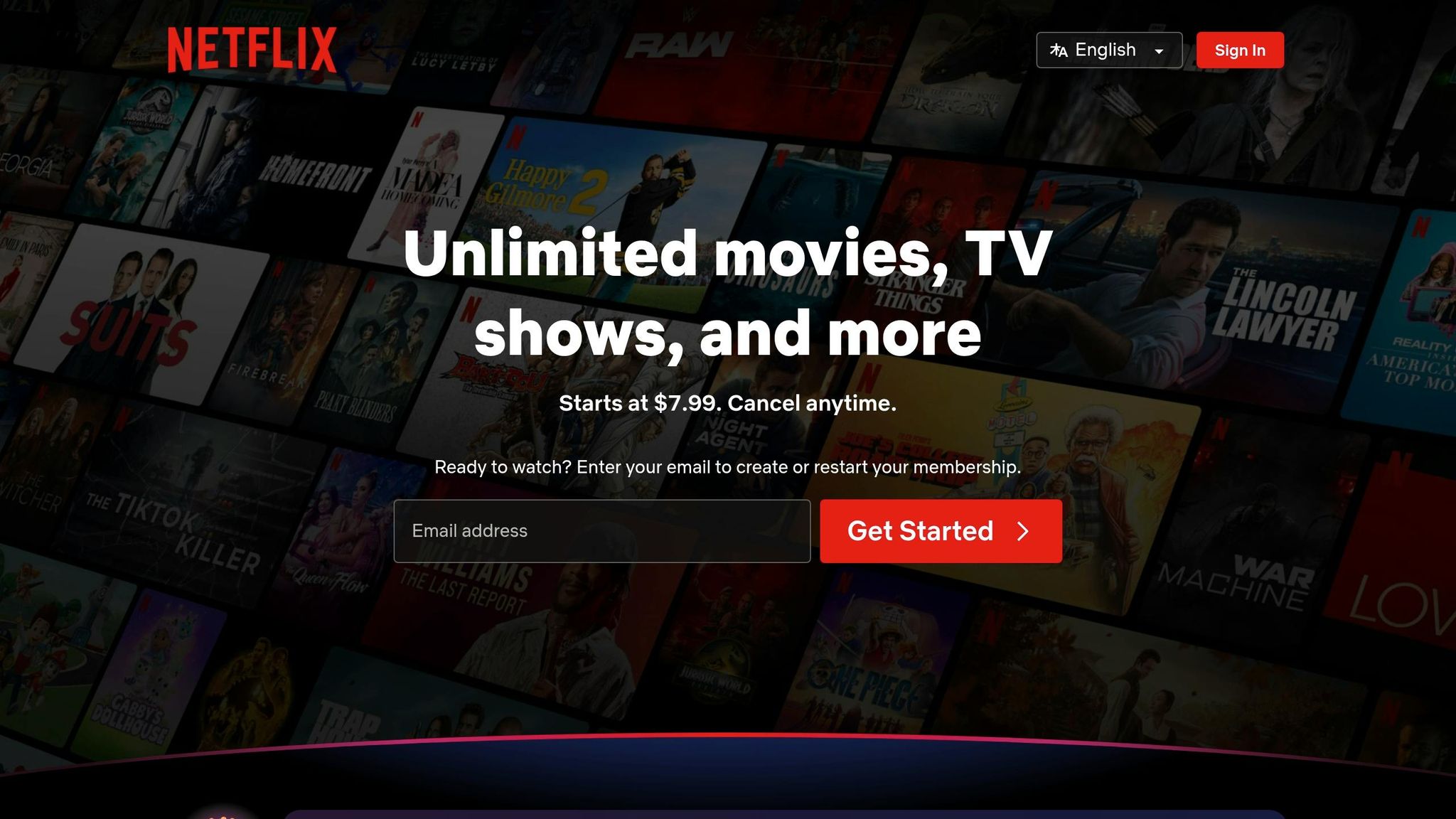
Netflix has mastered the art of keeping viewers engaged with its highly sophisticated recommendation engine. The goal? Help users find something to watch within just 60–90 seconds to prevent potential subscriber loss. To achieve this, Netflix tracks a range of micro-interactions, such as how far users scroll, how long they hover over thumbnails, whether they start trailers, and even how often they hit "skip intro". These tiny signals feed into a hybrid system that blends collaborative filtering, content-based filtering, and deep learning to predict the next show or movie a viewer might enjoy.
The results speak for themselves: over 80% of the content watched on Netflix comes from these recommendations, not manual searches. This system is so effective that it saves Netflix over $1 billion annually by reducing subscriber churn. With a churn rate of just 2.3% to 2.4%, Netflix far outpaces the industry average of 5% to 7%.
Netflix doesn’t stop at curating the homepage. The entire user experience is personalized, from the order of rows like "Continue Watching" to the specific titles displayed in those rows. Even the artwork and trailers adapt to individual preferences: for instance, fans of political dramas might see Kevin Spacey prominently featured, while those drawn to strong female leads might see Robin Wright. This level of thumbnail personalization can boost click-through rates by as much as 30%. On top of that, Netflix analyzes behavior across more than 2,000 "taste communities" to deliver hyper-targeted content.
Netflix’s data-driven approach extends to its original programming. When the company invested $100 million in House of Cards, it relied on data showing a strong overlap between fans of the original British series, director David Fincher, and actor Kevin Spacey. The result? Netflix Originals enjoy a 93% success rate, compared to just 35% for traditional pilots.
While Netflix focuses on making viewing choices seamless, Amazon applies a similar strategy to encourage purchases.
Amazon's Product Suggestions
Amazon, much like Netflix, uses real-time personalization to engage its users - but with a focus on driving sales. The company’s recommendation engine processes real-time data through tools like the Event Tracker and PutEvents API, tracking actions such as clicks, purchases, and product views. This enables Amazon to adapt its recommendations instantly, ensuring they align with a customer’s evolving interests.
Amazon employs Hierarchical Recurrent Neural Networks (HRNN) to analyze the sequence of user interactions and predict what customers are likely to buy next. It also incorporates metadata like device type, location, and time to fine-tune its suggestions. For new users, the system starts with popular items and adjusts quickly based on just a couple of interactions.
The impact is massive: personalized recommendations drive approximately 35% of Amazon’s total sales. The "Customers who bought" widget, a feature powered by collaborative filtering, consistently accounts for a significant portion of this revenue. Additionally, 56% of customers exposed to these personalized suggestions are more likely to become repeat buyers, while 57% say Amazon’s tailored approach helps them make better purchasing decisions.
"Deep learning helps the platform analyze which product(s) a customer is likely to buy next, further recommending the same to them while they're there on the site or when they log in again."
– Astha Khandelwal, Marketing Enthusiast, VWO
Both Netflix and Amazon show that real-time personalization is much more than a tool for improving user experience - it’s a powerful engine for driving revenue and long-term customer loyalty.
Real-Time vs. Batch Personalization Methods
Benefits of Real-Time Personalization
Real-time personalization works by analyzing and acting on user behavior within milliseconds to seconds, directly influencing decisions as they happen. This approach has been shown to boost engagement by up to 3.2x and drive noticeable conversion improvements. For example, in April 2024, Panera Bread partnered with Braze to integrate an AI-powered decision engine. This allowed them to deliver over 4,000 unique personalized offers through email, app, and web channels. The results? A 5% increase in retention among at-risk customers and a twofold jump in purchase conversions.
Another success story comes from Too Good To Go, which used real-time behavioral segments and API-triggered notifications. They alerted users when "Surprise Bags" became available based on their favorited items and current location, leading to a 135% rise in purchases tied to CRM efforts.
Real-time personalization also avoids the awkwardness of outdated recommendations. Unlike batch systems, which might suggest products a customer already bought hours ago, real-time systems stay current. Kevin Wang, Chief Product Officer at Braze, highlights the risk of outdated personalization:
"What makes these cases of mistaken personalization so jarring is that they undercut the customer relationship, revealing to people that your brand doesn't know them as well as they'd thought".
However, achieving this level of speed and accuracy isn't without its hurdles.
Challenges of Real-Time Personalization
Despite its advantages, real-time personalization requires a robust infrastructure that can be expensive to maintain. Unlike batch systems, which can rely on cost-saving "spot instances" during off-peak times, real-time systems operate 24/7, demanding continuous resources. Even slight delays can have significant consequences - page load times increasing from 1 to 3 seconds, for instance, can cause bounce rates to jump by 32%. To avoid this, real-time systems must keep latency under 200 milliseconds to deliver the instant responsiveness users expect.
The complexity of implementation is another hurdle. Real-time systems rely on a multi-layered architecture, including a data ingestion layer (feature stores), a processing layer for stream computation (tools like Apache Flink), and a serving layer for delivering low-latency recommendations. Managing streaming joins and aligning training with serving logic adds to the technical risks.
Interestingly, many platforms marketed as "real-time" actually operate on a micro-batching model, processing data every 15 minutes. While faster than traditional batch methods, this delay is too slow for in-session personalization. Dan George, Field CTO at Tealium, captures the problem well:
"If your 'real-time' system takes 15 minutes to process and retrieve data, that's like running into someone at the store, fumbling through an awkward conversation because you can't place them, and only then remembering exactly who they were after driving away".
Comparison Table: Real-Time vs. Batch Methods
Here's a quick overview of how real-time and batch personalization stack up:
| Metric | Real-Time Personalization | Batch Processing |
|---|---|---|
| Latency | Milliseconds to seconds | Minutes to days |
| Data Source | Live session behavior + historical context | Historical data dumps |
| Accuracy | High (contextual/intent-based) | High (historical patterns/trends) |
| Cost | Higher (always-on infrastructure) | Lower (scheduled/optimized compute) |
| Implementation | Complex (streaming pipelines, APIs) | Simpler (ETL, scheduled jobs) |
| Best Use Case | In-session offers, fraud detection | Monthly reports, seasonal campaigns |
| User Experience | Seamless, adaptive | Can feel "robotic" or delayed |
Adapting in Real Time: How to Use Personalization to Stay Ahead of Shifting Shopper Behavior
Conclusion: The Future of Real-Time Personalization
Real-time personalization has shifted from being a competitive edge to becoming a standard expectation. In fact, 88% of consumers are more likely to make a purchase when brands provide tailored experiences in real time.
With proven success in boosting conversions, advancements in machine learning and reinforcement learning are now making in-session adaptive personalization a reality. AI assistants, ranging from digital shopping guides to virtual health coaches, are using live user signals to operate autonomously. The AI-driven website personalization market is expected to grow at an annual rate of 21.7% between 2025 and 2033, with organizations leveraging AI across multiple functions seeing as much as a 32% increase in ROI.
"In 2026, relevance isn't a luxury; it's the baseline for meeting rising customer expectations".
The key challenge lies in implementing real-time personalization while managing privacy concerns and infrastructure costs. Businesses that focus on collecting first-party data, adopting composable architectures, and integrating real-time capabilities into their systems will be better equipped to thrive in this new landscape.
For companies ready to embrace these strategies, exploring platforms that support AI-driven personalization is crucial. As digital experiences continue to evolve, using advanced AI tools is no longer optional. Platforms like Top Website Builders (https://topwebsitebuilders.org) provide a directory of website building tools designed to simplify the integration of real-time personalized experiences.
FAQs
What counts as behavioral data for real-time personalization?
Behavioral data used for real-time personalization includes a variety of user actions such as page views, clicks, cart updates, browsing habits, purchase history, and engagement signals. By tracking and analyzing these activities, businesses can dynamically tailor content and offers, creating more engaging and relevant user experiences.
How fast does “real-time” need to be to improve conversions?
Real-time personalization needs to happen fast - we’re talking within about 600 milliseconds. This lightning-quick response time allows for dynamic, on-the-spot user experiences that can boost engagement and deliver measurable results.
How can I personalize in real time while staying privacy-compliant?
To offer real-time personalization while respecting privacy, start by relying on first-party data - information gathered directly from customer interactions. Make sure this data is anonymized, and always obtain explicit consent to stay aligned with privacy laws like GDPR or CCPA.
Use AI-powered tools to create tailored experiences dynamically, but ensure these tools respect individual privacy preferences. Focus on transparency, consent, and data security to build trust while delivering personalization that aligns with privacy standards.