Looking for a headless CMS for your SaaS business? Here’s a quick breakdown of the top 5 platforms dominating the market in 2026. These tools help you manage content centrally and deliver it across websites, mobile apps, and more using APIs, saving time and improving performance.
The Top 5 Platforms:
- Sanity: Developer-friendly with content-as-code, real-time editing, and GROQ query language. Great for multi-channel delivery.
- Contentful: Enterprise-grade CMS with robust APIs, governance tools, and multi-region support. Ideal for large-scale SaaS.
- Hygraph: GraphQL-native with content federation for integrating scattered data. Perfect for SaaS with complex architectures.
- Storyblok: Visual-first CMS with reusable content blocks and rapid deployment. Suited for marketing-driven teams.
- Strapi: Open-source and self-hosted flexibility with REST/GraphQL APIs. Best for startups and businesses needing data control.
Quick Comparison
| Platform | Starting Price | API Support | Key Features | Best For |
|---|---|---|---|---|
| Sanity | $15/user/month | REST, GraphQL, GROQ | Real-time editing, AI tools | Developer-led teams |
| Contentful | $300/month | REST, GraphQL | Enterprise tools, scalability | Large-scale SaaS |
| Hygraph | $199/month | GraphQL-native | Content federation | Complex SaaS architectures |
| Storyblok | $99/month | REST, GraphQL | Visual editor, reusable blocks | Marketing teams |
| Strapi | $0 (self-hosted) | REST, GraphQL | Open-source, full flexibility | Startups, data sovereignty |
Each platform offers unique strengths, from developer-focused tools to visual content management. Choose based on your SaaS needs, team structure, and budget.
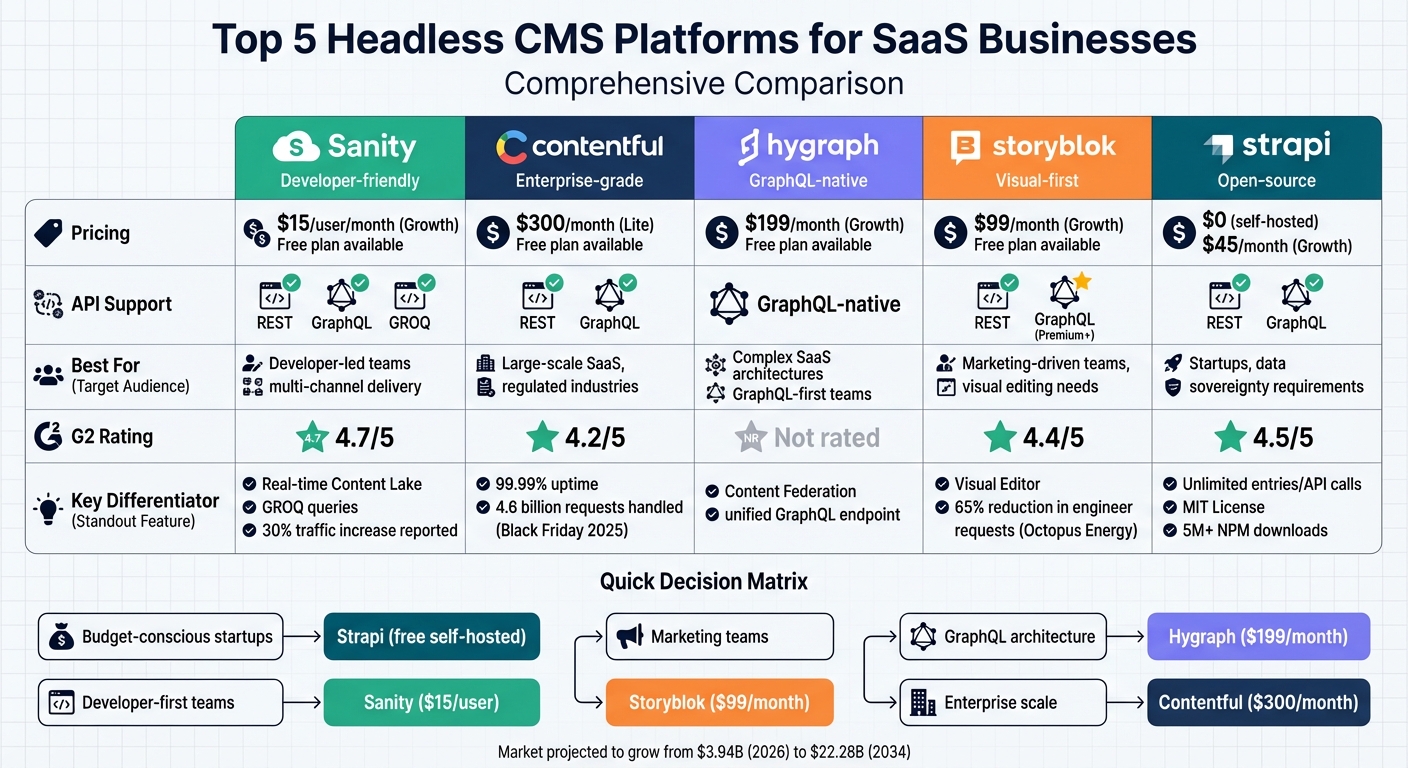
Top 5 Headless CMS Platforms Comparison for SaaS: Features, Pricing & Best Use Cases
Best Headless CMS for SaaS Companies (Don't Choose Wrong ! )
sbb-itb-94eacf4
1. Sanity
Sanity approaches content management differently by treating content models as code. Instead of relying on a web interface to structure content, you define schemas using TypeScript or JavaScript. This allows your content systems to be version-controlled alongside your application, ensuring consistency across environments. For SaaS teams, this is a game-changer, as it allows content infrastructure to be deployed just like any other piece of code.
Sanity's Content Lake stores content as structured JSON in a versioned database, complete with edit histories. It delivers global content in under 100 milliseconds using the Live Content API. For SaaS companies running multi-region applications, this kind of speed is essential. In 2026, Raft Labs highlighted that migrating high-traffic B2B SaaS websites to Sanity led to a 30% increase in organic traffic, all while avoiding downtime during the transition.
"With Sanity, we can tailor the open-source Studio to meet our content production needs and delight our site visitors, and at the same time, use their Content Lake to host our content. We love the agility and 'no-ops happy meal' that Sanity delivers." – Chad Alderson, Head of Marketing Design & Engineering, DataStax
SaaS Scalability Features
Sanity offers more than just speed; it’s packed with features designed to support scalable SaaS operations. For example, its real-time collaborative editing allows multiple team members to work on the same document simultaneously without conflicts. The Portable Text format ensures your content displays consistently across platforms - whether it’s on a website, mobile app, or in-app help widget - without requiring extra reformatting.
The AI Assist feature streamlines high-volume tasks like generating metadata or translating content with a single click, which is especially useful for SaaS companies expanding into international markets. Additionally, Content Releases make it easy to schedule global campaigns or roll back changes instantly.
Pricing in USD
| Plan | Price | Key Features |
|---|---|---|
| Free | $0 forever | 20 user seats, 2 public datasets, 500,000 API requests, 20GB bandwidth |
| Growth | $15 per seat/month | Up to 50 seats, private datasets, AI Assist, 2.5M API requests, scheduled publishing |
| Enterprise | Custom pricing | Custom seats/roles, SSO (SAML), 99.99% uptime SLA, dedicated support |
For a team of five, the Growth plan costs $75/month - significantly more affordable than Contentful's Lite plan, which costs $300/month. The Free plan is a great option for early-stage SaaS companies, while the Growth plan offers additional features like SAML SSO ($1,399/month), Dedicated Support ($799/month), and Increased Quota ($299/month).
API Types (REST/GraphQL)
Sanity supports REST, GraphQL, and GROQ (Graph-Relational Object Queries), its own query language. GROQ stands out because it lets you fetch exactly the data you need in a single request, avoiding over-fetching and improving frontend performance. While GraphQL is available, many developers favor GROQ for managing complex JSON structures. These API options make Sanity adaptable to a wide range of SaaS integration needs. This flexibility is a hallmark of advanced web building tools designed for modern digital ecosystems.
SaaS-Specific Use Cases
Sanity shines in scenarios where content needs to be synchronized across multiple platforms. For example, PUMA uses Sanity as the "connective tissue" for all its digital properties, ensuring consistent content delivery across global markets. The platform is ideal for multi-brand enterprises, B2B SaaS documentation systems, and global marketing sites requiring detailed localization. With over 1 million Sanity projects launched by 2026 and a #1 ranking among 85 CMS platforms on G2, Sanity has proven it can scale to meet the needs of SaaS companies at every stage.
2. Contentful
Contentful is a headless CMS designed for SaaS companies that need to deliver content across multiple channels from a single source. Unlike traditional CMS platforms that tie content to a specific frontend, Contentful uses APIs to treat content as structured data. This approach allows everything - from documentation to mobile apps - to pull from one central repository, making it easier to manage and scale.
One standout feature is its Spaces and Environments setup, which is perfect for SaaS teams handling multiple products or regions. Each Space acts as an independent content repository, and sandbox environments let developers test updates without affecting live content. For example, during Black Friday 2025, Contentful managed 4.6 billion delivery requests while maintaining a 99.99% uptime - an impressive feat.
"With Contentful, we were able to build a strong governance structure using tagging and permissions. This includes guardrails to ensure content is of quality and is checked end to end for bugs before publishing it to our live site." – Andrea Kramer, CMS Manager, Plaid
SaaS Scalability Features
Contentful offers tools tailored for SaaS scalability. Its AI-powered builders and AI Actions streamline repetitive tasks like generating SEO metadata, translating content into over 30 languages, and creating A/B test variations. These features can reportedly speed up go-to-market timelines by up to 10× and cut costs by as much as 50%.
The platform also includes enterprise-grade features like role-based access control (RBAC), Single Sign-On (SSO), and SCIM provisioning, which are essential for managing large, distributed teams. Its modular content architecture ensures consistent messaging across channels, while multi-region delivery and EU data residency options help SaaS companies meet global compliance standards. Developers benefit from robust API integrations, making it easier to adapt the platform to specific needs.
Pricing in USD
Contentful offers flexible pricing plans to accommodate different needs.
| Plan | Monthly Cost | Users | API Calls/Month | Key Features |
|---|---|---|---|---|
| Free | $0 | 10 | 100,000 | 1 Starter Space, 2 locales, 50GB CDN bandwidth |
| Lite | $300 | 20 | 1,000,000 | 3 locales, scheduled publishing, 100GB bandwidth |
| Premium | Custom | Custom | Unlimited | 99.99% uptime SLA, SSO, SCIM, custom spaces |
The Lite plan, priced at $300/month, is a good starting point for smaller SaaS operations. However, it’s worth noting that unexpected traffic surges could lead to costly overage fees. For larger needs, Premium plans start at $33,000 annually and can go up to $81,000, becoming more cost-effective for businesses with over 6 million API calls per month.
API Types (REST/GraphQL)
Contentful supports both REST and GraphQL APIs, giving developers flexibility in how they fetch content. The Content Delivery API (CDA) ensures global response times under 100ms, while the Content Management API (CMA) allows for programmatic updates. GraphQL is especially helpful for applications with complex data needs, as it reduces over-fetching by letting developers request only the specific data they need. Additionally, Contentful provides SDKs for popular programming languages like JavaScript, Python, Java, PHP, .NET, iOS, and Android. Its Images API even allows for real-time asset manipulation.
SaaS-Specific Use Cases
Contentful shines in scenarios where content needs to reach multiple platforms. For instance, Docusign uses it to scale personalized experiences for global audiences. As Michael Luzmore, Product Manager at Docusign, notes:
"To be successful, we needed to scale personalized experiences to global audiences. Contentful's flexible, extensible digital experience platform allows us to build compelling digital experiences for varied personas and experiment with AI tools that expedite our processes."
KFC Global relies on Contentful to manage content for kiosks, digital menu boards, and drive-thru systems. For B2B SaaS companies, common use cases include centralizing product documentation, managing onboarding content within apps, and running multi-region marketing campaigns. The platform’s advanced content modeling capabilities also help link related content - like product features, release notes, and help articles - ensuring everything stays in sync as your product evolves.
3. Hygraph
Hygraph takes a specialized approach, catering specifically to SaaS companies. It’s a GraphQL-native headless CMS, purpose-built to unify content from various sources without the hassle of migrating data. Unlike platforms that retrofit GraphQL onto older REST architectures, Hygraph was designed with GraphQL at its core. This allows it to handle both complex queries and dynamic content updates seamlessly.
One standout feature is its Content Federation. For SaaS teams dealing with scattered data across systems like PIMs, DAMs, or legacy databases, this feature offers a solution. Instead of consolidating all data into one platform, Hygraph creates a single GraphQL endpoint that integrates data from external sources. For example, Telenor, a Nordic telecom giant, used this to streamline metadata management for its video streaming service. This setup enabled them to launch 2,000 new titles monthly using GraphQL APIs. Similarly, Dr. Oetker utilized Hygraph’s MACH-certified architecture to manage brands across 40 countries, breaking down long-standing operational silos.
SaaS Scalability Features
Hygraph is built to scale with SaaS needs. It offers enterprise-grade infrastructure, including a dedicated Virtual Private Cloud (VPC) with isolated databases and compute instances that can expand as needed. The platform guarantees up to 99.9% API uptime and meets rigorous security standards like ISO 27001 and SOC 2 Type 2 compliance.
For global teams, Hygraph optimizes performance with a globally distributed edge cache and CDN-backed asset URLs, ensuring low latency for users worldwide. Additionally, its governance tools include detailed roles and permissions, audit logs, and sandbox environments for safe testing before deploying changes. Teams can also customize service limits for read/write operations, concurrent requests, and schema complexity, enabling smooth growth without sacrificing system integrity.
"Hygraph enabled us to scale content management while maintaining strict confidentiality across creators" – Christian Baur, Head of Gamescom & Events
Pricing in USD
Hygraph offers flexible pricing to suit SaaS companies at different stages of growth:
- Hobby plan: Free, includes 3 user seats, 5,000 content entries, and 500,000 API calls - ideal for startups testing ideas.
- Growth plan: $199/month, providing 10 seats, 20,000 entries, and Content Federation with one remote source.
- Scale plan: $799/month, designed for larger teams with 20 seats and 50,000 entries.
- Enterprise plans: Custom pricing for 100+ seats, over 1,000,000 entries, dedicated infrastructure, and 24/7 support with 1-hour response times.
Transparent overage fees include $0.20 per 10,000 API operations and $0.20 per 1 GB of asset traffic. Enterprise plans can handle over 50,000,000 API calls monthly, making costs per call drop significantly at higher volumes.
API Types (REST/GraphQL)
Hygraph is entirely GraphQL-native, focusing exclusively on GraphQL for content delivery and management. This means developers can use GraphQL mutations to create, update, or delete content directly via the API. The platform also includes a built-in API playground, making it easy for teams to test queries and mutations right within the CMS.
While Hygraph doesn’t natively support REST, its Content Federation feature bridges the gap by integrating data from external REST APIs. This approach allows SaaS teams to maintain a GraphQL-first environment while still working with legacy REST systems.
SaaS-Specific Use Cases
Hygraph’s API capabilities translate into tangible benefits for SaaS companies. For instance, Lick used the platform to build a modular eCommerce site with code export, leading to a 20% increase in "Add to Bag" conversions and doubling sales.
"After the launch of our new site, our 'Add to Bag' conversions increased by 20%. It was easier to build the modular site that we imagined to improve user experience without workarounds" – Joel Pierre-Powell, Principal Software Engineer at Lick
For B2B SaaS teams, Hygraph shines in managing multi-region product documentation, centralizing onboarding materials across platforms, and synchronizing marketing campaigns across markets. Its AI-driven tools can handle tasks like translation, summarization, and SEO optimization, helping teams expand operations without needing to scale their workforce proportionally.
"After the initial launch of new pages, the engineering team is not involved in the day-to-day work, allowing them to work on more challenging projects outside of just maintaining the website" – Harrison Stevens, VP of Marketing at Bellhop
4. Storyblok
Storyblok takes a visual-first approach to headless CMS, designed specifically for agile SaaS teams looking to streamline their content workflows.
This platform empowers marketers to manage content independently, thanks to its Visual Editor, which provides real-time previews for instant updates. This feature has proven invaluable for SaaS companies by cutting down delays. For instance, Octopus Energy reduced engineer requests by over 65% and now launches new websites in just five minutes.
Storyblok's modular "digital lego block" system enables scalable and reusable content creation using comprehensive site builder tools. TomTom utilized this architecture to create web pages in just 10 minutes. The platform also supports large-scale operations, handling over 9,000 pages and 54+ language variations for global businesses.
SaaS Scalability Features
Storyblok operates on AWS, offering a global CloudFront CDN to deliver content with minimal latency. The platform automatically adjusts to demand spikes, removing the need for manual scaling. With five data centers across three continents and multi-zone failover, it ensures resilience even during regional outages.
For enterprise users, Storyblok includes advanced governance tools like role-based access control (RBAC), Single Sign-On (SSO), and an Organization Manager for managing users across multiple projects. It also boasts a 99.99% uptime SLA for enterprise plans and holds ISO 27001 and TISAX certifications. According to a Forrester study, the platform delivers a 582% ROI, with users reporting a 50% boost in content operations speed and a 50% reduction in development time.
"Storyblok's configurable block-based model that enables composability and reusability... is exactly what I've been looking for and wanted from a content management system for all these years!" – Daniel Flassak, Software Developer, dmTech
Pricing in USD
| Plan | Monthly Price | API Requests | Included Seats | Uptime SLA | GraphQL API |
|---|---|---|---|---|---|
| Starter | $0 | 100k | 1 | N/A | No |
| Growth | $99 ($90.75 annually) | 1M | 5 | 97% | No |
| Growth Plus | $349 ($319.91 annually) | 4M | 15 | 97% | No |
| Premium/Elite | Custom | Custom | Custom | 99.9% – 99.99% | Yes |
Additional fees include $15 per extra seat per month, $10 for every 1 million API requests, and $75 for 250 GB of additional traffic. The Starter plan provides 100 GB of traffic and 100k API requests monthly, making it a great option for early-stage SaaS startups.
API Types (REST/GraphQL)
Storyblok offers both a RESTful Content Delivery API and a Management API for all plans, while the GraphQL Content Delivery API is exclusive to Premium and Elite tiers. The Management API allows programmatic content updates, which is ideal for automating workflows. The GraphQL API's structured schema also helps developers optimize frontend performance by avoiding over-fetching data - perfect for complex SaaS dashboards.
The platform includes a dedicated Image Service API for on-the-fly image optimization, eliminating the need for manual asset adjustments. Additionally, Storyblok offers SDKs for popular frameworks like Next.js, Astro, Nuxt, React, Vue, and Svelte, simplifying integration for developers.
SaaS-Specific Use Cases
Storyblok is particularly well-suited for SaaS companies managing multi-brand content hubs or requiring rapid deployments. For example:
- The National Retail Federation cut development time by 40% and achieved a perfect 100 Lighthouse SEO score after adopting Storyblok.
- Oatly leveraged the platform to drive three consecutive years of triple-digit growth.
- Virgin Media O2 saved "multimillions" by streamlining digital content management with Storyblok.
The platform's content staging pipelines also enable one-click deployment between development stages, making it an excellent choice for SaaS teams that need to test updates before going live.
"Developers appreciate the API-based system and how simple it is to use. Business users also love the interface with real-time preview with the Visual Editor." – Johannes De Zordo, Senior Frontend Developer, Marc O'Polo
5. Strapi
Strapi is the only open-source headless CMS on this list, offering flexibility through self-hosting or managed cloud options. Operating under an MIT license, it allows users to directly modify the source code. This makes it an excellent choice for FinTech and HealthTech SaaS companies needing strict compliance and data sovereignty. Strapi supports hosting on AWS, Google Cloud, or Azure, giving teams complete ownership of their data.
With its dual API approach, Strapi automatically generates REST and GraphQL endpoints as soon as content types are defined. This enables seamless multi-channel content delivery right out of the box.
Strapi has gained significant traction, with over 5 million NPM downloads and a community of more than 50,000 developers. Its reliability is reflected in a 4.5/5 G2 rating and over 65,000 GitHub stars.
"Strapi and Next.js both build on the same philosophy: open source is the path to success. Combine them with Vercel deployment and you have a stack with virtually infinite scalability, global performance, and security." – Guillermo Rauch, CEO, Vercel
SaaS Scalability Features
Strapi eliminates the typical limitations of headless CMS platforms by offering unlimited content entries, API calls, and content types across all pricing tiers, including the free Community edition. This makes it a scalable solution for SaaS platforms, whether in the prototype phase or full enterprise deployment.
The platform supports popular databases like PostgreSQL, MySQL, MariaDB, and SQLite for self-hosted setups. For those preferring managed infrastructure, Strapi Cloud offers a PaaS option with a 99.9% uptime SLA.
Enterprise features include advanced Role-Based Access Control (RBAC), Single Sign-On (SSO), and automated Review Workflows, making it ideal for managing large content teams. Additionally, Strapi AI simplifies global operations by automating tasks like content modeling, translations, and metadata generation.
Pricing in USD
| Plan | Monthly Price | Admin Seats | API Types | Key Features |
|---|---|---|---|---|
| Community | $0 | Unlimited | REST & GraphQL | Unlimited entries, MIT License |
| Growth | $45 | 3 (+$15/extra) | REST & GraphQL | Strapi AI, Live Preview, 30-day history |
| Enterprise | Custom | Custom | REST & GraphQL | SSO, Audit Logs, Review Workflows, 99.9% SLA |
For Growth plan users, the SSO add-on is available for $150 per month. While 65% of Strapi users stick to the free open-source version, self-hosting costs can range from $20 per month for basic setups to over $500 per month for enterprise-grade environments.
"Our partnership with the Strapi team enables us to give more flexibility and velocity to our product, marketing & customer care teams to manage content on the platform." – Francois Duprat, CPO
API Types (REST/GraphQL)
Strapi supports REST APIs for all content models and offers GraphQL through a plugin. Both API types are included in all pricing tiers, ensuring even free-tier users have access to high-level content delivery.
Developers can customize REST and GraphQL endpoints in the codebase to suit specific business needs. The GraphQL implementation allows precise queries and mutations, reducing data over-fetching and improving performance - especially for complex dashboards and mobile apps. This dual API strategy makes Strapi a strong choice for modern SaaS content delivery.
SaaS-Specific Use Cases
Strapi's scalability and robust API support make it a versatile tool for SaaS platforms. It’s particularly effective for:
- Product documentation systems: Content can be version-controlled and tied to product releases.
- In-app help and onboarding content: Allows updates without requiring a full application redeployment.
- Localization workflows: Simplifies global rollouts, ensuring faster entry into international markets.
By serving as a centralized content hub, Strapi ensures consistent messaging across web, mobile, and desktop applications. This capability is invaluable for SaaS teams managing omnichannel delivery.
"Technical setup was really quick, and in a few days we were able to have a drafted site up & running, leveraging Strapi main functionalities." – Jérôme Chauveau, DevOps Team Lead
Platform Comparison
When selecting a headless CMS for your SaaS, it's crucial to weigh factors like scalability, pricing, and API flexibility. Here's a comparison of key platforms to help you make an informed decision:
| Platform | Starting Price (USD) | API Support | Scalability Focus | Best SaaS Fit | G2 Rating |
|---|---|---|---|---|---|
| Sanity | $15/user/month | REST, GraphQL, GROQ | Real-time "Content Lake" | Developer-led teams, multi-channel delivery | 4.7/5 |
| Contentful | $300/month | REST, GraphQL | Enterprise infrastructure | Large-scale governance, regulated industries | 4.2/5 |
| Hygraph | $199/month | GraphQL-native | Content Federation | GraphQL-first architectures | Not rated |
| Storyblok | $99/month + $15/user | REST, GraphQL | Component-based blocks | Marketing-led teams, visual editing | 4.4/5 |
| Strapi | $0 (self-hosted) | REST, GraphQL | Self-hosted/Cloud flexibility | Startups, data sovereignty needs | 4.5/5 |
Key Insights on Each Platform
Sanity shines for developer-focused teams, offering real-time collaboration and precise content queries through its GROQ language. Its reliability was put to the test during Black Friday, handling high traffic seamlessly. In February 2026, Home Instead leveraged Sanity’s Content Agent to update Facebook links across 1,100 locations in a single conversational interaction.
Contentful provides enterprise-level performance, with cache hit rates exceeding 90% and the ability to handle up to 35,000 requests per second. This makes it a great option for large-scale, regulated industries. However, its $300/month starting price and usage-based costs can be steep for smaller SaaS companies.
Hygraph stands out with its content federation feature, allowing unified data retrieval from multiple sources via a single API call without duplication. This makes it ideal for SaaS businesses with complex architectures that need to integrate content from various systems.
Storyblok uses a component-based approach, which has proven to save significant development time. For instance, Education First was able to cut the timeline for building multilingual sites from 4–6 months to just 8 weeks.
Strapi offers a budget-friendly entry point, particularly with its free self-hosted option. However, self-hosted deployments typically require 45–48% more operational time compared to managed solutions, which can be a consideration for smaller teams.
"Sanity treats content like data. Contentful treats it like enterprise software. Storyblok resembles a design system, while Strapi is treated like code." – Vladimir Terekhov, Attract Group
Market Trends
The headless CMS market is projected to grow from $3.94 billion in 2026 to $22.28 billion by 2034, with a CAGR exceeding 21%. SaaS companies adopting headless CMS architectures often report 30–60% faster page loads and 20–40% improvements in Core Web Vitals scores. These benefits highlight the growing importance of choosing the right platform for scalability and performance.
Conclusion
A headless CMS shapes how your SaaS manages and delivers content across various platforms. Matt Biggin from Veza Digital highlights this perfectly:
"Choosing the best headless CMS for B2B SaaS is not simply a tooling decision, but it's also a content architecture choice".
Before diving in, take time to test it with real scenarios. Model a few content types - like a localized landing page or a product module - and have your team go through every step, from drafting to publishing. This process helps you gauge whether the platform aligns with your team's technical skills and workflow needs. Don't forget to factor in total costs, including frontend development and ongoing maintenance, which could be 2–5 times higher than traditional CMS options. These tests can give you a clearer picture of whether the platform supports your growth goals.
Headless CMS is ideal when your content needs to reach multiple platforms. For marketing-only websites, professional website builders might offer better returns. However, if your content strategy spans web, mobile, documentation portals, and other channels, headless architecture is built to scale with your business. As the market continues to grow, it’s clear this approach offers long-term potential.
To succeed, pick a platform that strikes a balance between developer flexibility and marketer independence. Gather a cross-functional team - developers, marketers, and product owners - to identify the must-have features and tackle major challenges, whether that’s improving marketing speed, ensuring data compliance, or managing multi-channel delivery.
FAQs
How do I choose the right headless CMS for my SaaS team?
To choose the best headless CMS for your team, start by assessing your specific needs, technical expertise, and future growth plans. Focus on factors like ease of use, scalability, integration options, and workflow capabilities.
For teams seeking technical flexibility, platforms like Sanity or Payload CMS are worth exploring. If managing visual content is a top priority, Storyblok stands out as a solid option. Additionally, Agility CMS and Directus are often praised for their user-friendly design and ability to work seamlessly in SaaS environments.
What costs should I expect beyond the listed monthly price?
When considering the monthly price, it's important to factor in additional expenses like hosting, bandwidth, API usage, localization, training, development, integration, and scaling. Also, keep an eye out for overage fees if your usage goes beyond the set limits. These extra costs can add up, so it's wise to plan ahead to avoid unexpected charges.
When is a headless CMS not worth it for a SaaS business?
A headless CMS might not be the best fit for a SaaS business if multi-channel content delivery isn’t a priority, or if the company lacks the technical team to manage it. In cases where simpler and more affordable platforms like WordPress or Webflow can handle the requirements, sticking with those options could make more sense. If the flexibility and API-driven capabilities of a headless CMS don’t outweigh the added complexity and cost, exploring other solutions may be a smarter choice.