Managing inventory is one of the biggest challenges for e-commerce businesses. Without the right tools, you risk stockouts, overselling, and wasted resources. The good news? Modern e-commerce platforms come equipped with inventory management features that can save you time, reduce errors, and improve efficiency.
Here’s a quick look at the 10 best e-commerce platforms that combine online store building with powerful inventory tools:
- Shopify: Best for businesses of all sizes with multi-location inventory tracking, barcode scanning, and seamless third-party integrations.
- WooCommerce: Perfect for WordPress users, offering flexible inventory tools through extensions like multi-warehouse support and barcode tracking.
- BigCommerce: Ideal for high-volume sellers with built-in multi-location tracking and integrations for advanced inventory needs.
- Wix eCommerce: Great for small to medium-sized businesses, featuring real-time inventory sync across online and offline channels.
- Dokan Cloud: Designed for multi-vendor marketplaces with vendor-specific inventory tools and localized fulfillment options.
- Weebly: A simple, budget-friendly option with Square integration for real-time inventory updates between online and physical stores.
- Squarespace: Combines sleek design with basic inventory tools, perfect for small businesses selling physical and digital products.
- Webnode: Tailored for small stores, offering basic stock tracking and product variant management.
- Fishbowl: Advanced inventory management for high-volume businesses, with features like barcode scanning and multi-warehouse support.
- NetSuite: A complete ERP solution for large enterprises, integrating inventory with finance, supply chain, and global operations.
Quick Comparison:
| Platform | Starting Price | Best For | Key Inventory Feature | Transaction Fees |
|---|---|---|---|---|
| Shopify | $32/month | SMBs to Enterprises | Multi-location tracking | Yes (unless using Shopify Payments) |
| WooCommerce | ~$39/month (est.) | WordPress Users | Customizable with extensions | Varies by payment gateway |
| BigCommerce | $29/month | High-Volume Sellers | Built-in multi-location tracking | No |
| Wix eCommerce | $17/month | Small Businesses | Real-time sync across channels | No |
| Dokan Cloud | Varies | Multi-Vendor Marketplaces | Vendor-specific inventory tools | Depends on plan |
| Weebly | Varies | Small Businesses | Square POS integration | Depends on payment gateway |
| Squarespace | $23/month | Small Businesses | Basic inventory tools | Yes (unless using Squarespace Payments) |
| Webnode | Varies | Small Stores | Basic stock tracking | Depends on payment gateway |
| Fishbowl | $229/month | High-Volume Businesses | Advanced warehouse tools | N/A |
| NetSuite | Custom Pricing | Large Enterprises | ERP with global inventory management | N/A |
Choosing the right platform depends on your business size, budget, and inventory complexity. Platforms like Shopify and BigCommerce are great for scaling businesses, while Wix and Squarespace cater to smaller operations. For larger enterprises, NetSuite offers comprehensive integration across all business functions. Let’s explore each platform in detail.
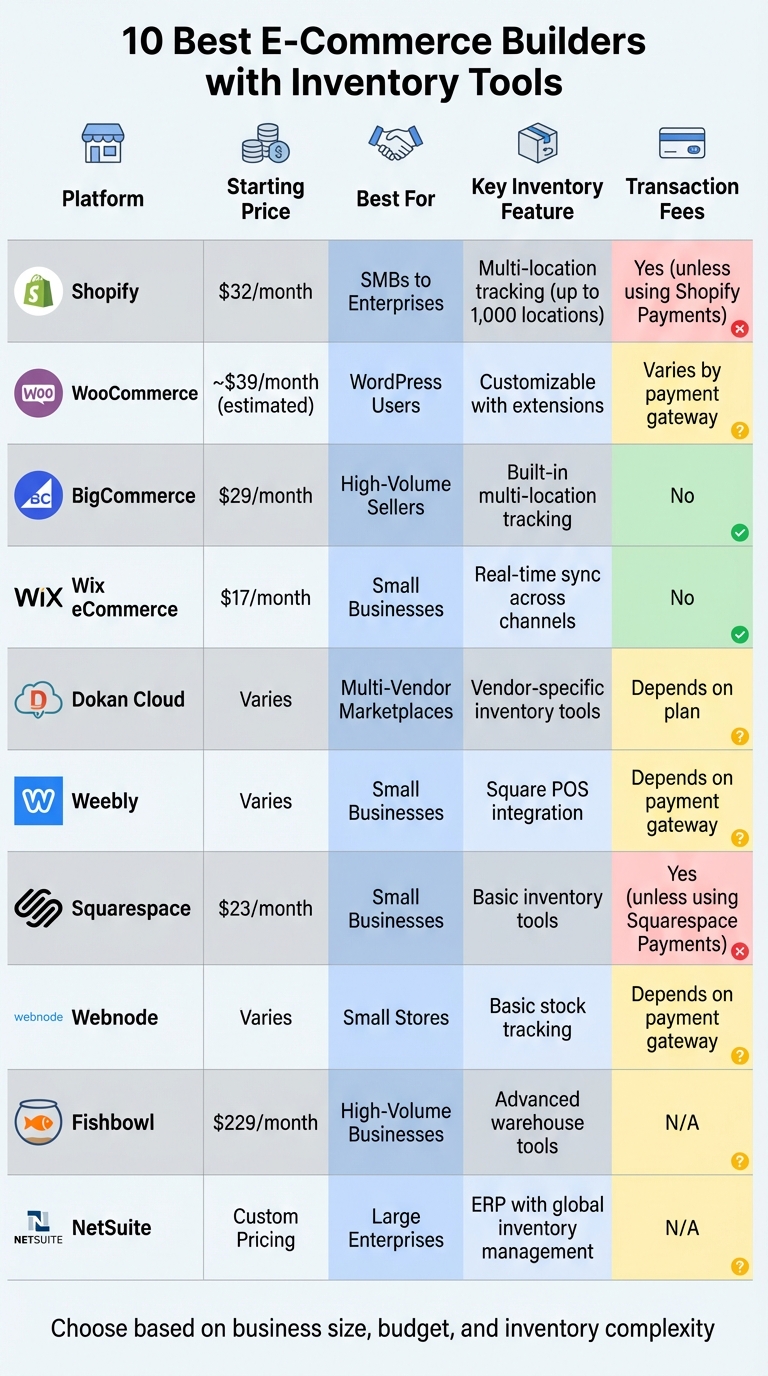
E-Commerce Platform Comparison: Features, Pricing, and Best Use Cases
Stop Wasting Time! 5 Ecommerce Inventory Management Software That Will Automate Your Stock in 2025
sbb-itb-94eacf4
1. Shopify

Shopify is built to handle businesses of all sizes, from a single storefront to operations spanning 1,000 locations. It connects warehouses, retail outlets, and fulfillment centers seamlessly. When a product sells - whether through your online store, Instagram Shop, or point-of-sale system - Shopify updates stock levels across all channels instantly. This ensures no double-selling, keeping inventory accurate everywhere.
Multi-warehouse support
Shopify’s order routing system selects the best warehouse for fulfilling orders based on factors like location, stock availability, and cost. If an order involves items stored at different locations, Shopify splits it into separate shipments and provides individual tracking for each. You can also move inventory between warehouses to better manage storage and handle spikes in local demand.
Oak + Fort, a clothing brand, streamlined their operations with Shopify, saving 50 hours of labor per week and cutting operating costs by 47%. Guillaume Jaillet, their Chief Omnichannel Officer, explained the key issue Shopify helped solve:
"It was hard to reliably and accurately represent which stores had certain items in stock to our digital customers when they wanted to try something on".
Barcode and batch tracking
Shopify simplifies inventory tracking with barcode scanning via its POS system, significantly reducing manual entry errors (1% error rate compared to 1 in 2.8 million with barcodes). For more advanced needs, it supports 2D barcodes, allowing businesses to track lot numbers and expiration dates. Regular inventory audits using these tools can lead to a sales boost of around 11% by correcting stock discrepancies.
Third-party integrations
Shopify’s App Store offers over 8,000 apps to expand its functionality. Tools like LitCommerce (4.8/5 stars, 552 reviews) sync inventory across 20+ marketplaces, while Prediko ($49/month) uses sales data to predict reorder needs. For high-volume operations, warehouse management apps like SKULabs ($299/month) provide features like scanner-assisted picking.
Pricing tier entry points
Shopify’s pricing is flexible, catering to businesses at different stages. The Basic plan ($29/month) includes multi-location tracking for up to 10 locations. The Advanced plan ($299/month) adds features like ABC analysis and inventory days tracking. Enterprise-level merchants can opt for Shopify Plus, starting at $399/month for the first three months, which supports up to 200 locations. Shopify has earned a 4.4/5 rating on G2, with users highlighting its unified admin panel for managing both online and physical stores.
2. WooCommerce
WooCommerce is a free, open-source plugin designed for WordPress that gives users control over inventory management. Unlike some platforms that come with extensive inventory features built-in, WooCommerce relies on additional extensions to provide similar functionality. Instead of paying fixed monthly fees, you only cover the costs of hosting, security, and the specific features you select. The core plugin includes tools for tracking stock levels, setting low-stock alerts, and managing product variations like sizes or colors. However, it doesn't natively support multi-warehouse operations or barcode scanning. Let’s take a closer look at how WooCommerce's ecosystem addresses these limitations.
Multi-warehouse Support
Out of the box, WooCommerce doesn’t support multi-warehouse management. To overcome this, you can use extensions like WooCommerce Multi Locations Inventory Management ($99/year) or ATUM Multi-Inventory, which allow you to assign stock to different warehouses. These tools also enable inventory allocation and order routing across multiple locations, making them essential for businesses managing stock in various locations.
Barcode and Batch Tracking
If barcode scanning is a priority, third-party tools can fill the gap. For example, Simple Inventory Management ($65/year) enables barcode scanning to reduce manual entry errors. Additionally, ATUM's free core plugin (with premium add-ons starting at about €20 per quarter) offers batch tracking and supports FIFO/LIFO inventory methods. These features are especially useful for industries like food, cosmetics, and pharmaceuticals, where precise tracking is critical.
Third-party Integrations
WooCommerce’s flexibility shines through its compatibility with various third-party plugins. For instance:
- Stock Sync ($89/year) helps synchronize inventory across up to 10 stores and marketplaces like Amazon and eBay.
- Katana MRP ($199–$359/month) supports manufacturing management, including tracking raw materials and bills of materials.
- Smart Manager ($199/year) simplifies bulk editing and can save up to 10–15 hours of work each week.
These integrations enhance WooCommerce's capabilities, making it adaptable for a wide range of business needs.
Pricing Overview
Because WooCommerce itself is free, your total costs depend on the extensions and services you choose. For smaller, DIY operations, expenses for hosting, domain registration, and basic plugins typically range from $500 to $2,000 annually. Larger businesses, on the other hand, may face first-year costs as high as $139,000, with ongoing annual expenses averaging about 4.5% of revenue.
WooCommerce currently holds a 20.1% share of the professional website builders market. Notable plugins like ATUM have earned a 4.7/5 rating on WordPress.org, while Stock Sync boasts a perfect 5/5 rating.
3. BigCommerce
BigCommerce is a SaaS platform that simplifies inventory management by offering multi-location tracking straight out of the box. This feature lets you monitor stock across warehouses, distribution centers, and retail stores - all from a single dashboard. With support for up to 600 SKUs per product and 250 options, you can manage a wide range of product variations, including sizes, colors, and materials, with precision. Plus, real-time syncing across major sales channels like Amazon, eBay, Walmart, and social media ensures you avoid overselling.
Multi-warehouse Support
BigCommerce’s multi-location functionality allows you to assign inventory to specific warehouses, enabling features like "Buy Online, Pick Up In-Store" (BOPIS). It also supports split shipments, backorders, and pre-orders across multiple locations [3, 49]. A great example of its impact is TradeTools, an Australian hardware retailer that switched from Adobe Commerce in 2025. After migrating, they saw a 31% boost in revenue, a 25% increase in order volume, and reduced costs. Mark Vourlides, their Marketing and Ecommerce Manager, shared:
"Magento was much more expensive, especially when we were up for renewal. It had doubled from what we initially signed for".
While the platform excels in multi-location management, businesses seeking advanced barcode and batch tracking may need additional tools.
Barcode and Batch Tracking
BigCommerce includes native SKU tracking but doesn’t offer built-in barcode or batch tracking. To add these features, you can integrate third-party tools like SKULabs or Fishbowl [55–57].
Third-party Integrations
BigCommerce takes an "Open SaaS" approach, offering strong API connections to ERP systems, PIM tools, and 3PL providers. Key inventory partners include Brightpearl (ideal for businesses generating over $1M in revenue), Linnworks (for detailed reporting), and Cin7 Omni (for seamless omnichannel sales). Additionally, the platform provides single-click integrations with enterprise software like NetSuite. These integrations enhance the platform’s inventory management capabilities, complementing its built-in features.
Pricing Tier Entry Points
BigCommerce’s Standard plan starts at $29–$39 per month and includes unlimited products with multi-channel integration. The platform also charges 0% transaction fees, no matter your payment processor. Pricing scales based on trailing 12-month sales: Standard supports up to $50,000–$75,000 in sales, Plus up to $180,000–$225,000, and Pro for $400,000+ [58, 61]. With a 4.4/5 rating on Capterra, the platform delivers an average 211% ROI within three years.
4. Wix eCommerce
Wix eCommerce is a no-code solution tailored for small to medium-sized businesses, capable of managing up to 50,000 products. It ensures real-time inventory synchronization across your online store, Amazon, eBay, and social media platforms [64, 65]. Users can track exact quantities or manually adjust stock levels, with inventory updates triggered as soon as an order is placed or payment is made. Oren Inditzky, Vice President and General Manager of Online Stores at Wix, emphasizes:
"Wix is not only an eCommerce website builder. It covers all types of business, and as such, it can allow you to further grow and expand your business".
Multi-warehouse Support
Wix takes inventory management a step further by supporting multiple physical locations, such as warehouses and retail stores, through its POS integration [63, 73]. This functionality allows each location to maintain its own stock levels, which is especially helpful for features like in-store pickup. The Wix Owner mobile app even includes a barcode scanner, making it easy to update inventory on the go.
Third-party Integrations
Wix eCommerce connects with over 800 apps via the Wix App Market, offering tools like ShipBob for third-party logistics, Multiorders for managing multichannel fulfillment, and Modalyst for dropshipping [67, 69]. For businesses with unique needs, Wix provides Open APIs and the Velo development platform, enabling secure integrations with external ERPs or proprietary inventory systems [67, 70, 72]. Additionally, you can perform batch updates for up to 300 items at once through the Wix Inventory tab.
Pricing Tier Entry Points
Wix eCommerce offers plans starting at $29 per month for the Core plan, which includes basic inventory tools, 50GB of storage, and support for up to 25 dropshipping products [75, 77]. The Business plan, priced at $36 per month, provides 100GB of storage, while the Business Elite plan costs $159 per month and includes unlimited storage and advanced eCommerce features [75, 77]. All plans come with a free 256-bit SSL certificate, DDoS protection, and PCI compliance [67, 69]. In addition, Wix's SEO tools and automated email features can help businesses boost their revenue.
5. Dokan Cloud

Dokan Cloud is a no-code platform tailored for multi-vendor marketplaces, currently supporting over 50,000 active online stores worldwide. Unlike platforms built for single-store setups, Dokan Cloud allows multiple vendors to operate independently within a centralized marketplace. With its unified vendor dashboard, users can access real-time data on inventory, earnings, and best-selling products, enabling vendors to fine-tune their sales strategies using advanced e-commerce development platforms. Beyond marketplace management, the platform also streamlines inventory logistics.
Multi-warehouse Support
The "Multiple Locations" feature in Dokan Cloud allows vendors to list multiple office or warehouse facilities, aligning with a "Global Reach, Local Touch" approach. This feature helps vendors manage inventory across various regions and supports both physical and online storefronts. By offering localized fulfillment options, vendors can build customer trust and improve delivery efficiency.
Third-party Integrations
Dokan Cloud integrates with key tools to simplify operations. For automated fulfillment and custom shipping rules, it works with Shippo. Payment processing is handled through Stripe and PayPal, enabling automated split payments between marketplace owners and vendors. Additional integrations include Mailchimp for email campaigns, Twilio for SMS notifications, Google Analytics 4 for performance tracking, and WhatsApp for customer communication. While these integrations enhance functionality, the platform leans heavily on essential features of website builders for online stores like its built-in inventory management tools to keep operations smooth.
Pricing Tier Entry Points
Dokan Cloud provides access to all features across its pricing plans, with differences limited to user counts and revenue share percentages. New users can explore the platform with a $1 per month trial for the first three months or opt for a 14-day free trial without needing a credit card. All plans come with perks like unlimited product listings, bulk CSV import/export, and dynamic product variations (e.g., color, size, material). The platform boasts a customer satisfaction rate exceeding 90% and a 4.6/5 rating on G2, based on 11 reviews.
6. Weebly

Weebly caters to over 40 million users with its drag-and-drop website builder and e-commerce tools. After being acquired by Square, Weebly has enhanced its inventory management, making it easier to sync stock between online and physical stores in real time. Here's a closer look at how Weebly's integrations and pricing plans support inventory management.
Third-party Integrations
Weebly's App Center offers access to more than 360 third-party apps to boost its functionality. One standout feature is its integration with Square, which automatically synchronizes inventory between online stores and Square POS systems, enabling features like in-store pickup. For businesses that require more advanced inventory capabilities - such as multi-channel management or warehouse logistics - Weebly integrates with platforms like ShipStation (starting at $9/month), Extensiv Order Manager, and ShipMonk. Additionally, payment processing is supported in 25 countries via PayPal and in 11 countries through Stripe.
Pricing Tier Entry Points
Weebly includes inventory management tools in all its plans, from free to premium:
- Free Plan: Allows unlimited product listings but doesn't include a custom domain.
- Personal Plan ($9/month): Adds support for custom domains and selling digital goods.
- Professional Plan ($16/month): Offers unlimited storage and advanced site analytics.
- Performance Plan ($29/month): Removes the 3% transaction fee, includes abandoned cart recovery, and supports PayPal payment processing.
All paid plans come with bulk CSV import/export tools and "low in stock" badges to help streamline inventory tracking.
"Weebly is a capable platform for building online stores... It's packed with tools for online marketing and ecommerce, including an email newsletter builder and inventory management."
- Michael Graw, Freelance Writer, Top10.com
7. Squarespace

Squarespace combines sleek design options with built-in tools for managing inventory, making it a great choice for selling physical goods, services, and digital products. Its features include stock tracking, SKU management, low-stock alerts, and inventory synchronization across storefronts. Plus, importing product catalogs is straightforward.
Third-party Integrations
Squarespace extends its functionality through its Extensions marketplace, offering a range of tools to enhance inventory and order management. For example:
- inFlow Cloud: Automatically tracks stock levels.
- SKU IQ: Synchronizes inventory between POS systems and online stores.
- Trunk: Provides real-time inventory syncing.
For businesses with more advanced needs, Finale Inventory supports multi-warehouse management and mobile barcode scanning. Shipping integrations like ShipStation and AfterShip simplify the fulfillment process.
"Squarespace Extensions are services offered by other companies that can be integrated into your Squarespace website... to add additional features... such as sourcing new products, selling outside of Squarespace, syncing orders and inventory, and streamlining shipping."
- Katie Burger, Squarespace Blog
Pricing Tier Entry Points
Squarespace has four subscription tiers, all billed annually:
- Basic Plan: $16/month, supports unlimited products with built-in inventory tools but includes a 2% transaction fee.
- Core Plan: $23/month, eliminates transaction fees and allows custom third-party integrations.
- Plus Plan: $39/month, adds advanced inventory tracking and POS support.
- Advanced Plan: $99/month, unlocks Commerce APIs and abandoned cart recovery features.
8. Webnode

Webnode offers an inventory management system tailored for small to medium-sized online stores. It helps you keep track of product availability and quantities for individual items, including variants like different sizes or colors. Each variant can have its own price, SKU, and stock level, making it easier to manage diverse product lines.
The platform simplifies store management with features like bulk CSV import, an order status dashboard, and synchronized stock levels across multiple language versions. These tools work seamlessly alongside Webnode's extensive comprehensive site builder tools and integration options.
Third-party Integrations
Webnode connects with essential tools for website creation through the team.blue ecosystem. For invoicing and payment tracking, you can integrate with Billdu, while SimplyBook.me is available for managing service bookings. Shipping solutions like DHL and FedEx ensure smooth order tracking, and payment gateways such as Stripe, PayPal, Klarna, and Paytrail handle secure transactions. Additionally, you can embed Google Analytics to track store performance and understand customer behavior.
Pricing Tier Entry Points
Webnode's e-commerce features are available with its Premium Plan. The Standard Plan starts at $16.90/month (billed annually), while the Profi Plan, at $26.50/month, includes features like product variants, product feeds, and 7 GB of storage. For more advanced needs, the Business Plan costs $34.90/month, offering automatic invoicing, multi-currency support, and 15 GB of storage.
9. Fishbowl
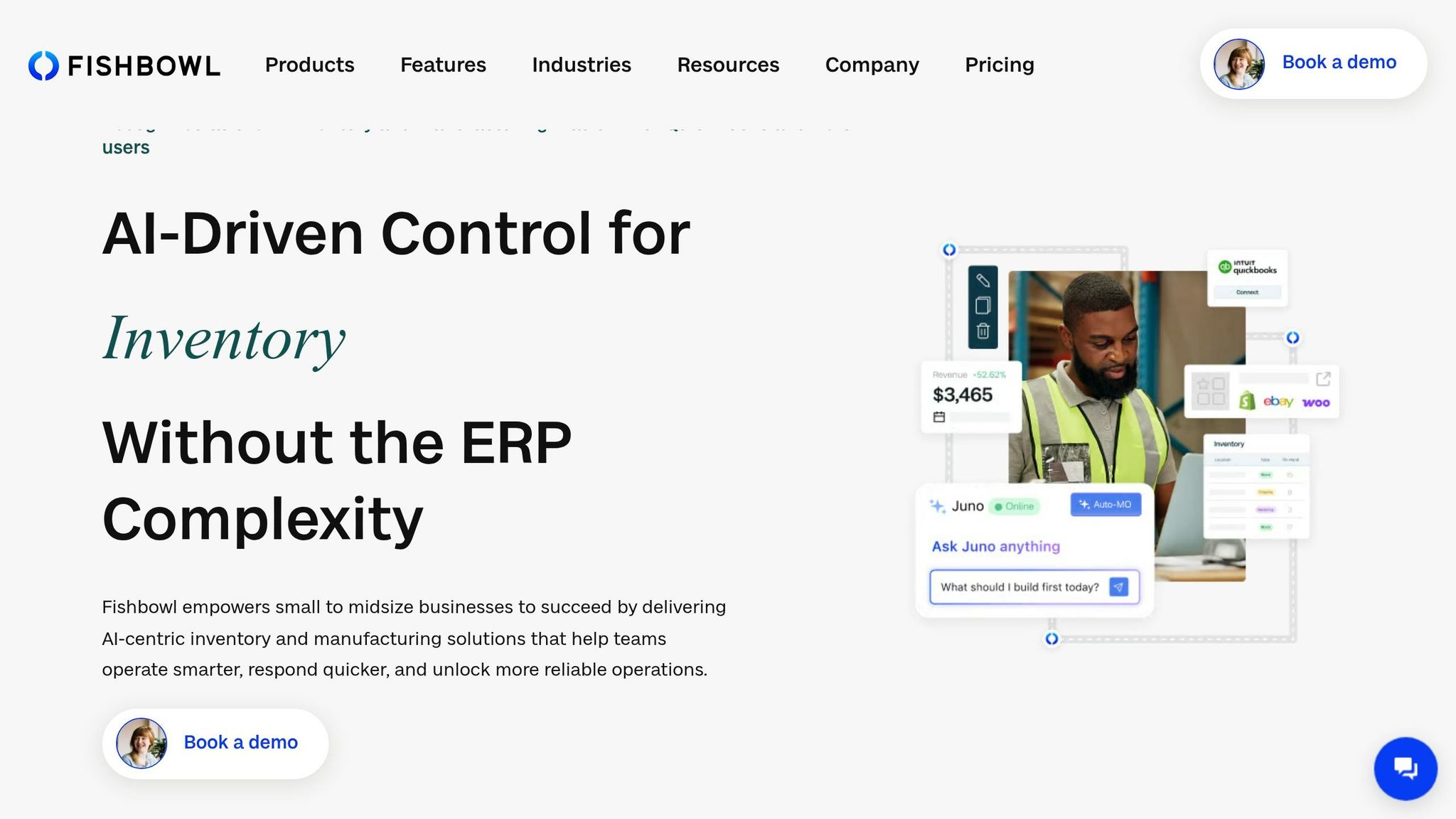
Fishbowl is designed for high-volume e-commerce businesses that require advanced inventory management across multiple locations. Unlike store website builders, Fishbowl focuses on handling complex warehouse and manufacturing workflows, making it a go-to solution for businesses with intricate supply chains and large-scale operations.
The platform has already transformed operations for over 6,000 businesses. For instance, Mack & Rex, a B2C retailer, automated their order entry system using Fishbowl Commerce. This saved them 50 hours per week and cut annual costs by over $100,000 through more accurate inventory tracking. Similarly, Koken USA saw an 8% boost in sales thanks to AI-powered demand forecasting and reduced sales backorders by 17%. Let’s dive into its standout features.
Multi-Warehouse Support
Fishbowl offers real-time visibility across unlimited warehouses and sub-locations, a feature included in all pricing tiers at no additional cost. Businesses can set customized reorder points for each location to avoid stockouts and use transfer orders to move inventory between warehouses without needing to record a sale. Sajani Cups and Cones, an ice cream company, leveraged this feature to expand their product catalog from 3,000 to 5,500 items, showcasing the system’s scalability.
Barcode and Batch Tracking
The Fishbowl Go app turns your smartphone into a mobile barcode scanner, enabling real-time picking, packing, and cycle counting. Beyond basic scanning, the platform supports tracking by lot numbers, serial numbers, and expiration dates, giving businesses precise control over their inventory. Thanks to these capabilities, Grill Works Inc. achieved a 99% on-time delivery rate.
Third-Party Integrations
Fishbowl seamlessly connects with major e-commerce platforms like Shopify, Amazon, BigCommerce, eBay, WooCommerce, and Walmart. For accounting, it integrates with QuickBooks Online, QuickBooks Desktop, and Xero, offering near-real-time two-way synchronization. Additionally, it works with shipping carriers such as FedEx, UPS, USPS, and DHL, as well as CRM tools like Salesforce and HubSpot.
"Fishbowl has completely changed how we handle inventory and job costing. We used to chase down numbers across systems, but now everything is synced." - Ryan Doty, Accountant, Fierce Firearms
Pricing Tier Entry Points
Fishbowl’s pricing starts with the Essentials plan at $229/month (billed annually), which includes 2 users, SKU management, cycle counts, and unlimited locations. The Growth plan costs $429/month and adds 5 users, shipping tools, and AI reporting. The Scale plan, priced at $729/month, supports 10 users and includes forecasting and advanced AI features. For enterprise needs, the Advanced plan offers custom pricing. Note that Fishbowl requires an implementation package with a 6-8 week training program, starting at $4,000.
10. NetSuite
NetSuite is designed for large-scale e-commerce businesses that require advanced inventory management across multiple sales channels. This cloud-based ERP platform integrates e-commerce storefronts and warehouse operations with financial systems, making it ideal for companies handling complex, multi-country shipping and large product catalogs.
With a customer base of over 43,000 worldwide and a 99.9% uptime record over the past nine years, NetSuite has proven itself reliable. Mielle Organics, for example, leverages NetSuite to maintain detailed audit trails. Melvin Rodriguez, COO of Mielle Organics, shared:
"I needed an inventory management system where everything is traceable. In NetSuite, I can see related records and every activity associated with a particular order - at the detail level - for auditing".
These features set the stage for advanced warehouse management, which is explored further below.
Multi-Warehouse Support
NetSuite offers a unified, real-time view of inventory across all storage locations, including warehouses, retail outlets, third-party logistics providers, and drop shippers. The system uses predefined rules to select the most efficient warehouse, cutting down on split shipments and shipping costs. Additionally, inventory transfers between locations help prevent stockouts and reduce the risk of overstocking.
With its Smart Count feature, cycle counting becomes automated without disrupting warehouse operations. AI-driven Narrative Insights provide context-specific summaries, such as back-order details, directly on location and item pages. SuiteCommerce further integrates e-commerce storefronts with back-office inventory, keeping everything in sync automatically.
Barcode and Batch Tracking
NetSuite’s WMS module enhances efficiency with mobile RF barcode scanning for tasks like wave picking and cycle counting, reducing picking errors by 67%. It also supports lot and serial number tracking across all storage locations, which is especially beneficial for industries with strict regulations. However, these advanced barcode features are part of the WMS module, which comes with an additional monthly cost of $1,000–$2,000.
Third-Party Integrations
The SuiteApp Marketplace offers hundreds of business tools tailored to NetSuite’s ERP platform. It integrates seamlessly with major shipping carriers, payment gateways like PayPal and Adyen, and tax services such as Avalara through its Commerce Extension Framework and APIs. Marketing tools also centralize customer data and automate workflows, including cart abandonment reminders. Bogdan Rancea, Co-founder of Ecommerce-Platforms.com, highlights its capabilities:
"NetSuite WMS is a full-scale solution for large operations. When paired with the full NetSuite environment, it connects inventory, finance, purchasing and warehouse tasks in one place".
Pricing Tier Entry Points
NetSuite operates on a quote-based pricing model, which includes a base license fee, per-user costs, and additional module charges. The Starter Edition starts at around $999 per month, covering up to 10 user licenses and one legal entity. Full-access user licenses are priced at approximately $129 per month, while self-service licenses for tasks like time and expense tracking range from $10 to $25 per month.
For e-commerce functionality, SuiteCommerce Standard costs $2,499 per month, while SuiteCommerce Advanced is priced at $4,999 per month. Implementation fees can vary widely, ranging from $15,000 to over $150,000, depending on the complexity. Notably, 85% of implementations succeeded when companies used consultants, and 83% of businesses achieved their ROI goals after being live for over a year.
Feature and Pricing Comparison
Finding the right e-commerce platform hinges on your business size, budget, and how complex your inventory needs are. Below is a table breaking down the basics - starting prices, inventory strengths, best-fit businesses, and transaction fee details.
| Platform | Starting Price | Best For | Key Inventory Strength | Transaction Fees |
|---|---|---|---|---|
| Shopify | $32/month | SMBs to Scaling Startups | Handles up to 1,000 inventory locations; native POS support for omnichannel retail | Yes (unless using Shopify Payments) |
| WooCommerce | ~$39/month (est.) | SMBs using WordPress | Open-source with limitless customization for diverse products | Depends on payment gateway |
| BigCommerce | $29/month | Large Enterprise / B2B | Scales for high-volume needs with bulk pricing and quote tools | No |
| Wix eCommerce | $17/month | Small Business / Solopreneurs | Offers visual design tools and basic inventory tracking | No |
| Dokan Cloud | Varies | Multi-Vendor Marketplaces | Vendor-specific inventory and marketplace management | Depends on plan |
| Weebly | Varies | Small Businesses | Simple inventory tracking integrated with Square tools | Depends on payment gateway |
| Squarespace | $23/month | Small Businesses / Creatives | Sleek design focus with basic inventory and branding tools | Yes (unless using Squarespace Payments) |
| Webnode | Varies | Small Businesses | Basic stock management for smaller catalogs | Depends on payment gateway |
| Fishbowl | One-time payment | SMBs using QuickBooks | Advanced warehouse tools like kitting and automated work orders | N/A (not a storefront) |
| NetSuite | Custom (high) | Global Large Enterprise | Full ERP with multi-currency, multi-language, and multi-warehouse features | N/A (enterprise ERP) |
The table gives an overview, but let’s dive deeper into what makes these platforms stand out for different needs.
Shopify and BigCommerce are top choices for mid-market businesses. Shopify shines with its POS system and large inventory location capabilities, while BigCommerce provides scalability and skips transaction fees, which is great for businesses managing high volumes. If you’re a WordPress user, WooCommerce offers unmatched flexibility, though you’ll need to budget for hosting and extensions. For smaller businesses, Wix eCommerce and Squarespace combine user-friendly design features with basic inventory tools, making them ideal for solopreneurs or creatives.
For larger enterprises, NetSuite integrates inventory with finance, HR, and supply chain tasks, making it a powerhouse for global operations. On the other hand, Fishbowl is a great fit for QuickBooks users looking for advanced warehouse tools without committing to a full ERP system.
With nearly 93% of U.S. consumers expected to shop online by 2027, scalability is a key factor when choosing the best online store builders. Transaction fees also play a big role in overall costs. Platforms with lower or no fees can improve customer retention by as much as 20%, making fee structures an important consideration for long-term growth and inventory management efficiency.
Conclusion
Picking the right e-commerce platform comes down to matching your inventory needs with tools that can grow alongside your business. For smaller retailers managing 10–50 products, platforms like Wix or Squarespace offer user-friendly design features and straightforward inventory management. As your product range grows, options like Shopify or BigCommerce provide more advanced syncing capabilities and scalability, helping you cut back on the need for extra add-ons. These platforms also cater to businesses that require smooth integration between online and offline operations.
If you run a physical store, real-time point-of-sale (POS) integration is a must. Platforms such as Shopify and Square Online excel at syncing in-store and online inventory, reducing the risk of overselling. For those using WordPress, WooCommerce offers extensive customization options, but keep in mind - you’ll need to handle hosting and security on your own.
Don’t overlook the total cost of ownership. For high-volume sellers, BigCommerce can be a cost-effective choice, thanks to its zero transaction fees. This feature alone could save merchants between $5,800 and $30,000 annually compared to platforms that charge per-sale fees. Also, factor in hidden expenses like app subscriptions, premium themes, and payment gateway fees.
Integrating your platform with existing tools can boost efficiency and scalability. For example, if you use QuickBooks for accounting, adding warehouse management software like Fishbowl can simplify inventory tracking and financial management. With nearly 93% of U.S. consumers projected to shop online by 2027, choosing a platform that can handle growing traffic and an expanding product catalog is critical for staying competitive.
"The platform you choose today dictates the creative and technical limitations you'll face tomorrow. Prioritizing a flexible, scalable ecosystem is the single most important decision for long-term growth." - Itamar Haim, Web Creation Expert
FAQs
Which platform is best for multi-location inventory?
The article "36 Best Multi-Location Inventory Software for 2026" dives into the leading platforms tailored for businesses managing inventory across various locations. It reviews tools that help simplify inventory tracking and improve operations for companies operating in multiple sites.
Do I need barcode scanning for inventory accuracy?
Barcode scanning is a game-changer for managing inventory, particularly in e-commerce and warehouse environments. It helps cut down on manual errors, speeds up stock-taking processes, and keeps inventory levels accurate and reliable.
Although not required, using barcode systems can significantly boost efficiency, reduce stock discrepancies, and offer better oversight of inventory. For businesses looking to streamline order fulfillment and stay competitive, it's a tool worth considering.
What costs matter beyond the monthly plan price?
When evaluating a platform, it's essential to look beyond the monthly plan price. Additional costs can include transaction fees, payment gateway charges, fees for add-ons or plugins, and expenses for extra features or upgrades. These can add up quickly and affect your total budget, so take the time to assess these details thoroughly before making a final decision.