By 2026, privacy-first analytics tools are becoming essential for businesses navigating stricter data regulations like GDPR and CCPA. Open-source platforms offer a clear advantage: full data control, transparency, and compliance. This guide covers 12 tools that prioritize privacy, self-hosting, and accurate data insights without relying on third-party trackers or cookies.
Key Highlights:
- OpenPanel: Advanced product and web analytics with lightweight tracking and cookieless compliance.
- PostHog: Combines product analytics, session replays, and A/B testing in one platform.
- Plausible: A straightforward, privacy-first web analytics tool with a tiny tracking script (<1 KB).
- Matomo: Trusted by governments for unsampled analytics and full data ownership.
- Umami: Lightweight and simple web analytics, perfect for developers and small businesses.
- Ackee: Minimalist analytics for essential metrics, self-hosted with no cookies.
- Pirsch: Server-side tracking with privacy features and ad-blocker bypass.
- Swetrix: Combines analytics, performance monitoring, and error tracking.
- Shynet: Cookie-free analytics with a lightweight tracking script and full data control.
- Countly: Designed for product and behavioral analytics across platforms.
- Snowplow: A data infrastructure tool for event-level insights and AI-driven analytics.
- KNIME: A low-code platform for data science and advanced analytics workflows.
These tools cater to diverse needs, from simple web analytics to complex product tracking and AI-powered insights. Whether you're running a blog, managing enterprise systems, or building advanced data pipelines, there's a solution here for you.
Quick Comparison
| Tool | License | Self-Hosting | Focus Area | Privacy Features |
|---|---|---|---|---|
| OpenPanel | AGPL-3.0 | Yes | Web + Product Analytics | Cookieless, GDPR compliant |
| PostHog | MIT | Yes | Product Analytics | Consent-based features |
| Plausible | AGPL-3.0 | Yes | Web Analytics | Lightweight, no cookies |
| Matomo | GPL-3.0 | Yes | Web Analytics | Full data ownership |
| Umami | MIT | Yes | Web Analytics | Cookieless, lightweight |
| Ackee | MIT | Yes | Minimalist Web Analytics | Anonymized tracking |
| Pirsch | AGPL-3.0 | Yes (Enterprise) | Web Analytics | Server-side tracking |
| Swetrix | AGPL-3.0 | Yes | Web + Performance Metrics | Cookieless, GDPR compliant |
| Shynet | Apache 2.0 | Yes | Web Analytics | Cookie-free, self-hosted |
| Countly | AGPL-3.0 | Yes | Product Analytics | GDPR/CCPA compliant |
| Snowplow | Custom | Yes | Behavioral Data Platform | Data sovereignty |
| KNIME | GPL-3.0 | Yes | Data Science + ETL | Local processing |
Choose the tool that aligns with your privacy needs, technical expertise, and analytics goals.
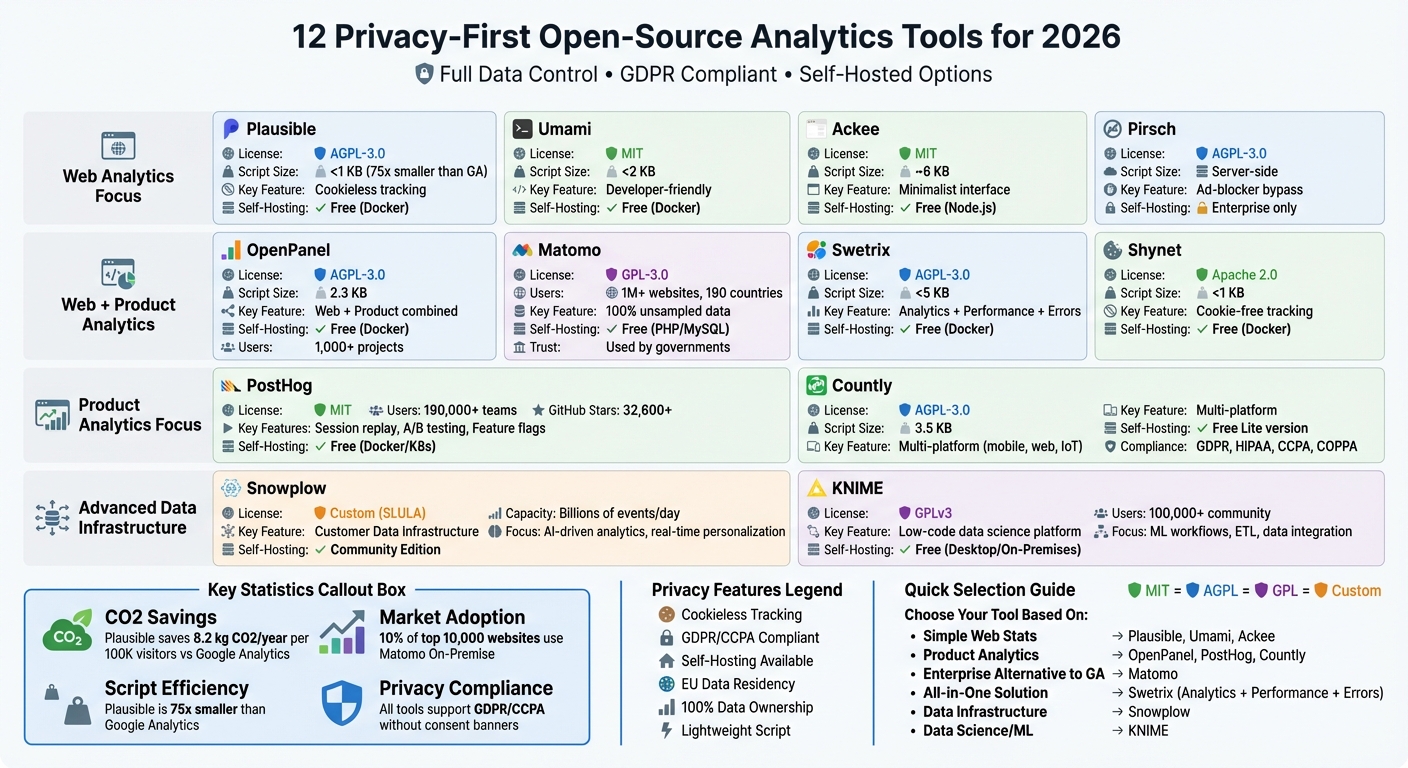
Open-Source Analytics Tools Comparison: Features, Licensing, and Privacy
Umami: The Open Source Google Analytics Alternative
sbb-itb-94eacf4
1. OpenPanel
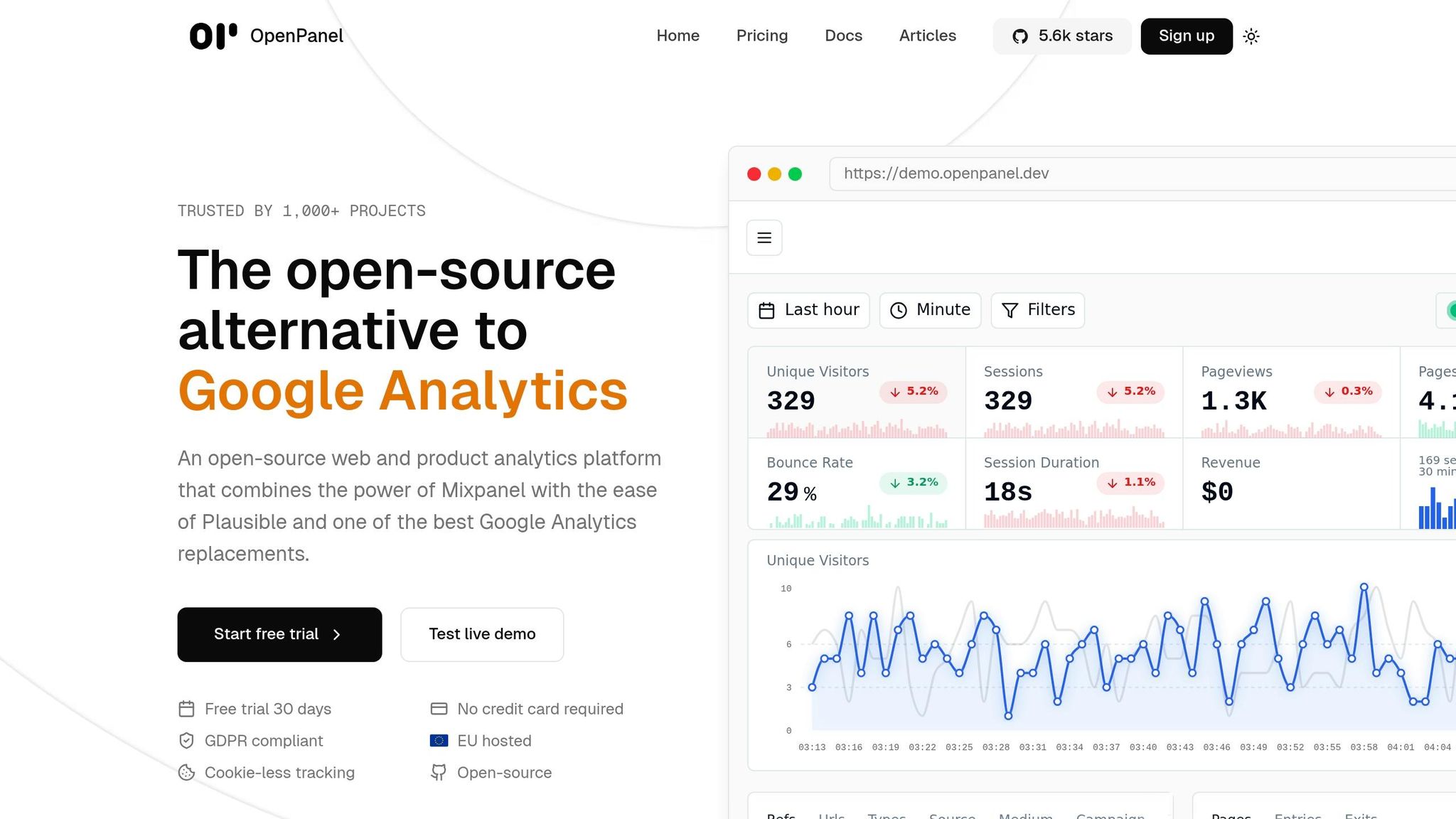
OpenPanel is a go-to solution for businesses prioritizing privacy and seeking integrated analytics for web and product performance. By early 2026, it had been implemented in over 1,000 projects. It offers enterprise-grade features comparable to Mixpanel, with the added benefit of complete data ownership. Let’s break down its standout features.
License Type
OpenPanel is licensed under AGPL-3.0, giving businesses the ability to review the code for security and compliance. Meanwhile, its SDKs are distributed under the more flexible MIT license, simplifying integration across different applications. This dual licensing model ensures flexibility and unrestricted self-hosting.
Self-Hosting Support
You can deploy OpenPanel on a VPS with at least 4 vCPU, 8 GB of RAM, and an SSD. The setup process is straightforward - just clone the repository, navigate to the self-hosting folder, and run the setup script:
git clone -b self-hosting https://github.com/Openpanel-dev/openpanel && cd openpanel/self-hosting && ./setup
Primary Focus
OpenPanel delivers a mix of analytics capabilities. It covers standard web metrics like traffic sources and pageviews, alongside advanced product insights such as funnels, retention cohorts, user profiles, and session histories.
Privacy Features
OpenPanel takes privacy seriously. It employs daily rotating salts for IP hashing, enabling cookieless tracking that avoids long-term fingerprinting. At just 2.3 KB gzipped, its SDK is incredibly lightweight - about 13 times smaller than Google's gtag.js. This not only ensures faster loading but also reduces the likelihood of being flagged by ad blockers. As a result, businesses often sidestep the need for intrusive consent banners while staying compliant with GDPR and CCPA regulations.
2. PostHog
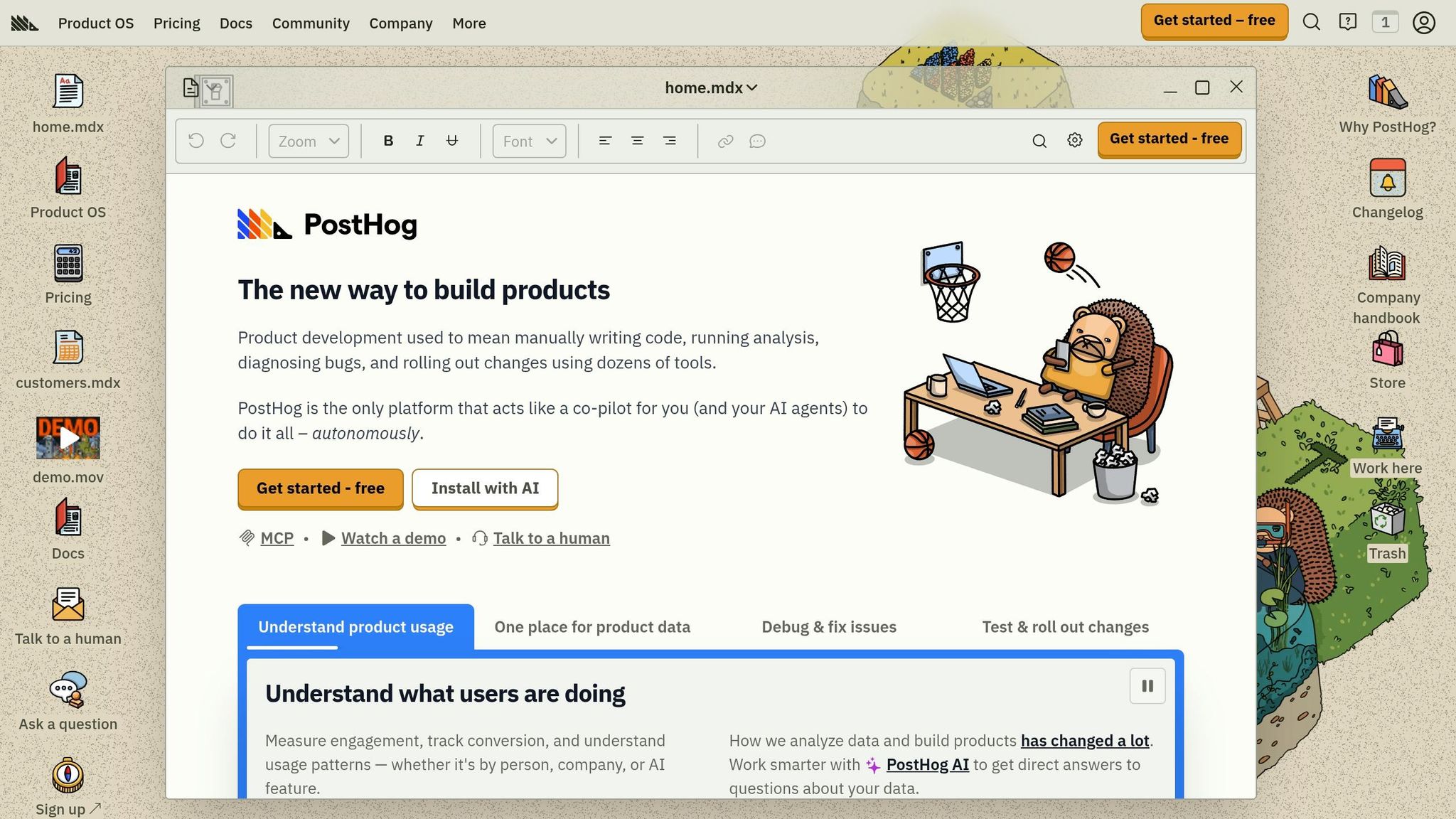
Building on OpenPanel's privacy-focused approach, PostHog brings a comprehensive toolkit tailored for product teams. It combines product analytics, session replays, feature flags, A/B testing, and LLM analytics into a single platform. With over 32,600 stars on GitHub and adoption by more than 190,000 teams globally, PostHog has established itself as a popular choice for organizations seeking robust analytics solutions.
License Type
PostHog operates under a dual-license model. Its core repository is licensed under the MIT Expat license, allowing teams to modify and extend the platform freely. However, its Enterprise Edition (ee) includes proprietary features governed by a separate licensing agreement. For those strictly requiring an open-source solution, PostHog offers posthog-foss, a read-only version stripped of proprietary components.
Self-Hosting Support
PostHog supports self-hosting for teams that prefer managing their own infrastructure. You can deploy it using Docker or Kubernetes (via Helm charts). For smaller setups, the hobby deployment requires at least 4 GB of RAM and can handle up to 100,000 events per month. Installation is straightforward with the following command:
/bin/bash -c "$(curl -fsSL https://raw.githubusercontent.com/posthog/posthog/HEAD/bin/deploy-hobby)"
For larger-scale needs, PostHog recommends transitioning to its Cloud service, as self-hosting involves managing dependencies like ClickHouse, Kafka, PostgreSQL, and Redis, which can demand significant resources.
Primary Focus
PostHog is designed for behavioral product analytics, focusing on features like funnels, retention cohorts, user paths, and session replays. These tools cater to teams aiming for engineering-driven, product-led growth. Additionally, its LLM analytics feature helps monitor the performance of AI-based applications. This focus on actionable insights makes PostHog a strong option for teams prioritizing advanced analytics over basic web metrics.
Privacy Features
Privacy is a key consideration for PostHog. To meet GDPR requirements, it provides EU data residency through its Cloud EU hosting in Frankfurt, Germany. The platform also supports consent management and allows users to request the full deletion of their data. A noteworthy feature is its billing structure - anonymous events are charged at 55–80% lower rates compared to identified events, ensuring cost efficiency while maintaining high privacy standards. These features align with the stringent compliance expectations of 2026.
3. Plausible

Plausible offers a straightforward and privacy-focused approach to web analytics, standing in contrast to PostHog’s more feature-rich product analytics toolkit. With over 24,600 stars on GitHub, Plausible has gained recognition as a lightweight alternative to Google Analytics. Its tracking script is impressively compact - less than 1 KB, making it 75 times smaller than Google Analytics. For a website with 100,000 monthly visitors, this translates to saving approximately 8.2 kg of CO₂ emissions annually.
License Type
The Plausible Community Edition is governed by the GNU Affero General Public License Version 3 (AGPLv3) [23,24]. However, to simplify licensing for website owners, its JavaScript tracker is distributed under the more permissive MIT license. This dual licensing approach ensures flexibility while maintaining open-source principles.
Self-Hosting Support
For those who prefer self-hosting, Plausible Community Edition (CE) is available via Docker Compose. However, it requires a solid understanding of Docker, databases, and server management. Your server hardware must support SSE 4.2 or NEON instruction sets, with a minimum of 4 GB RAM for stable performance. For production environments, 8 GB or more is recommended. While the self-hosted version benefits from long-term support updates twice a year, the cloud-hosted version is updated multiple times per week. This setup aligns with Plausible's focus on privacy and usability.
Primary Focus
Plausible is designed with privacy-first web analytics in mind, offering a simple and clean dashboard that prioritizes essential metrics. It avoids the complexity of larger, enterprise-level platforms, making it ideal for users who value ease of use when using website building tools. SEO Consultant Cyrus Shepard shared his experience:
"My 100% favorite GA4 alternative so far is Plausible. Not free and not a ton of bells and whistles, but SOOOO easy to use (for clients too) and the data is near real-time".
Privacy Features
Plausible places privacy at the forefront. It doesn’t use cookies, nor does it collect personal data or IP addresses, ensuring compliance with GDPR, CCPA, and PECR regulations - no consent banners are needed [23,25,26]. Instead, it tracks unique visitors using a hash function with a daily salt that is rotated and deleted every 24 hours. For its cloud service, Plausible processes all data on European servers (hosted by Hetzner in Germany) to meet Schrems II requirements. The cloud version also filters bot traffic by excluding approximately 32,000 data center IP ranges, while the Community Edition uses basic User-Agent filtering.
4. Matomo
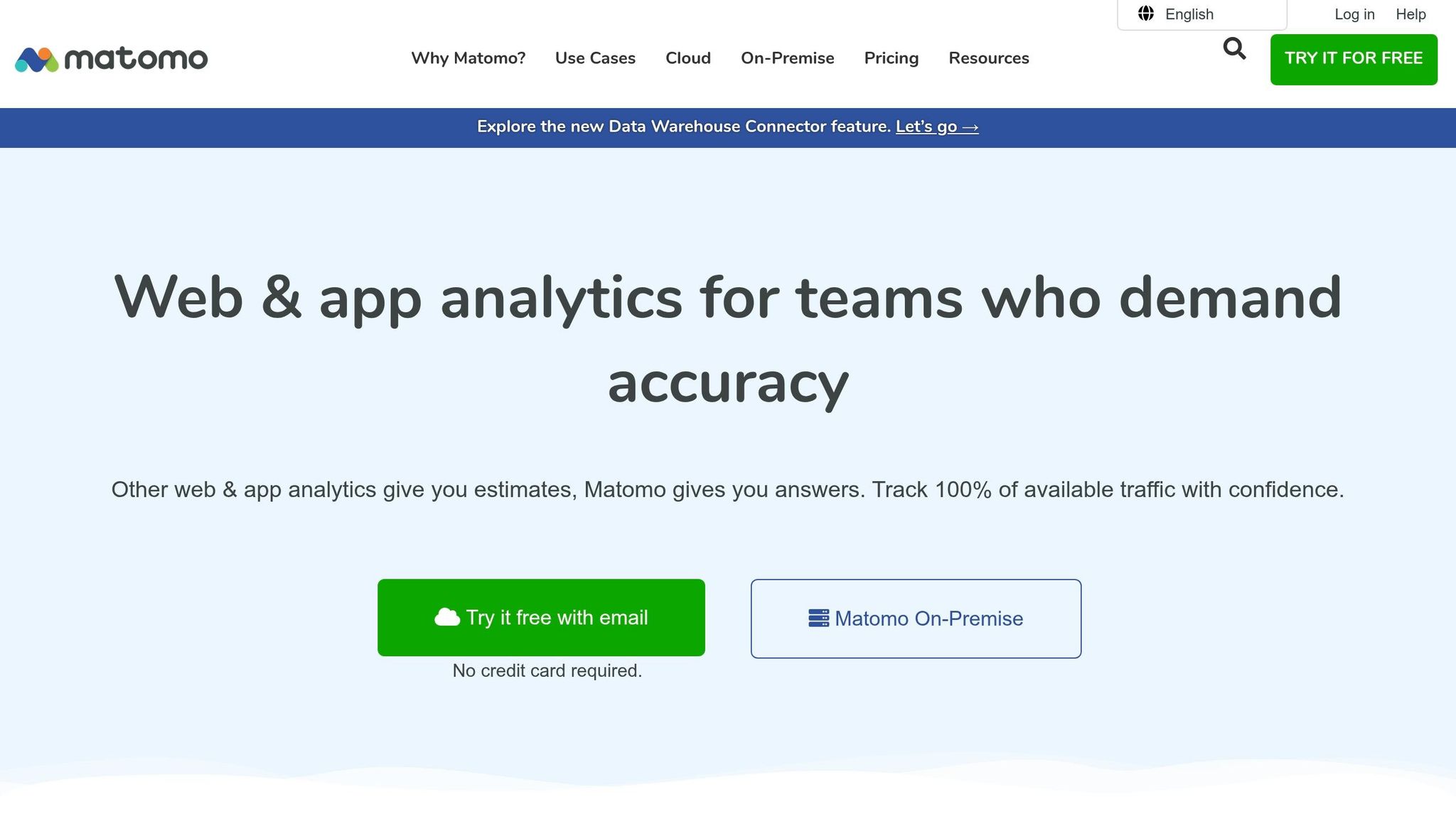
Matomo is a well-established open-source analytics platform, trusted by over 1 million websites across 190 countries. Impressively, around 10% of the top 10,000 websites globally use its On-Premise version for their analytics needs.
License Type
Matomo operates under the GNU GPL v3.0 (or later) license. This ensures users have 100% data ownership and eliminates concerns about vendor lock-in. The platform thrives on a community-driven development model, with contributions from more than 400 developers, ensuring a transparent and well-maintained codebase.
Self-Hosting Support
Matomo's self-hosted version, Matomo On-Premise, is free to download and install on your own servers. It has no restrictions on the number of sites, users, or traffic. This approach ensures that all data remains solely between you and your visitors, with no involvement from third parties. For organizations in tightly regulated industries, this is a major advantage, as it allows them to store data in specific locations to comply with local data sovereignty laws. A notable example is the Czech government, which moved its national websites to a self-hosted Matomo instance during the COVID-19 pandemic to keep data within EU borders.
For WordPress users, the "Matomo for WordPress" plugin offers an easier setup process, though it does require basic server administration skills.
Primary Focus
Matomo emphasizes comprehensive web and product analytics while prioritizing privacy and data sovereignty. Unlike many competitors, it provides unsampled reports, meaning it analyzes 100% of your data rather than relying on statistical approximations. The platform also integrates seamlessly with over 100 popular CMS and top webshop platforms, including WordPress, Shopify, and Magento. For those seeking advanced capabilities, premium features like A/B testing, heatmaps, and funnel analysis are available as paid add-ons, starting at approximately $39 per year.
In early 2026, Alloy transitioned from Google Analytics 4 to Matomo to take advantage of its unsampled reporting and advanced integrations. Their Head of Marketing and Co-founder, Ramon Khan, shared:
"I can trust that the data it's recording is accurate and can be validated in the tool."
This move reportedly led to a noticeable revenue increase within just a few months.
Privacy Features
Matomo gives users full control over their data. It protects visitor privacy by anonymizing IP addresses, removing one to three bytes. It also supports cookieless tracking, eliminating the need for additional consent banners. The platform is certified under the ISO 27001:2022 standard for security management and includes a built-in GDPR Manager to handle right-to-erasure requests and data retention periods, which can range from one month to indefinite. These privacy-focused features, combined with its extensive analytics capabilities, make Matomo a standout choice for organizations prioritizing data control and security.
5. Umami
Umami has established itself as a favorite among developers, earning over 36,100 stars on GitHub as of early 2026. It's perfect for those seeking straightforward, fast web analytics without the complexities of larger enterprise platforms.
License Type
Umami uses the MIT license, one of the most permissive open-source licenses available. This allows developers and businesses to freely use, modify, and distribute the software with almost no restrictions. Unlike tools licensed under AGPL, Umami doesn't require you to disclose your source code when making modifications or deploying the software over a network. Plus, there's no feature limitation between the self-hosted and cloud versions.
Self-Hosting Support
For those who prefer self-hosting, Umami makes it simple. Deployment is easiest with Docker Compose (the recommended method), but you can also install it directly from the source code. Starting with Umami v3, PostgreSQL (v12.14+) is required as the database engine, as MySQL is no longer supported. It’s important to update the default credentials ("admin"/"umami") immediately for security. In production, using a reverse proxy like Caddy or Nginx is advised to manage SSL/HTTPS and restrict direct access to port 3000. Impressively, Umami can run efficiently on a $5/month VPS, making it an affordable choice for developers and small businesses alike. This ease of deployment highlights its focus on simplicity and performance.
Primary Focus
Umami is all about lightweight web analytics, with growing features in basic product analytics like funnels and retention tracking. Its tracking script is under 2 KB, ensuring minimal impact on website performance. Small businesses and developers can rely on Umami to deliver essential metrics without the complexity of enterprise tools. For those who prefer a managed solution, Umami Cloud offers a free tier supporting up to 100,000 events per month, while the Pro tier starts at $20 per month for up to 1 million events.
Privacy Features
Privacy is at the core of Umami’s design. It operates cookieless by default, eliminating the need for cookie consent banners to meet GDPR requirements. The platform avoids collecting personally identifiable information (PII) and doesn't use browser fingerprinting. Since Umami is self-hostable, users retain complete control of their data, which stays on their own servers. As stated in the documentation, "Your analytics data never leaves your servers." This makes Umami a standout choice for organizations that prioritize data ownership and compliance with privacy regulations.
6. Ackee
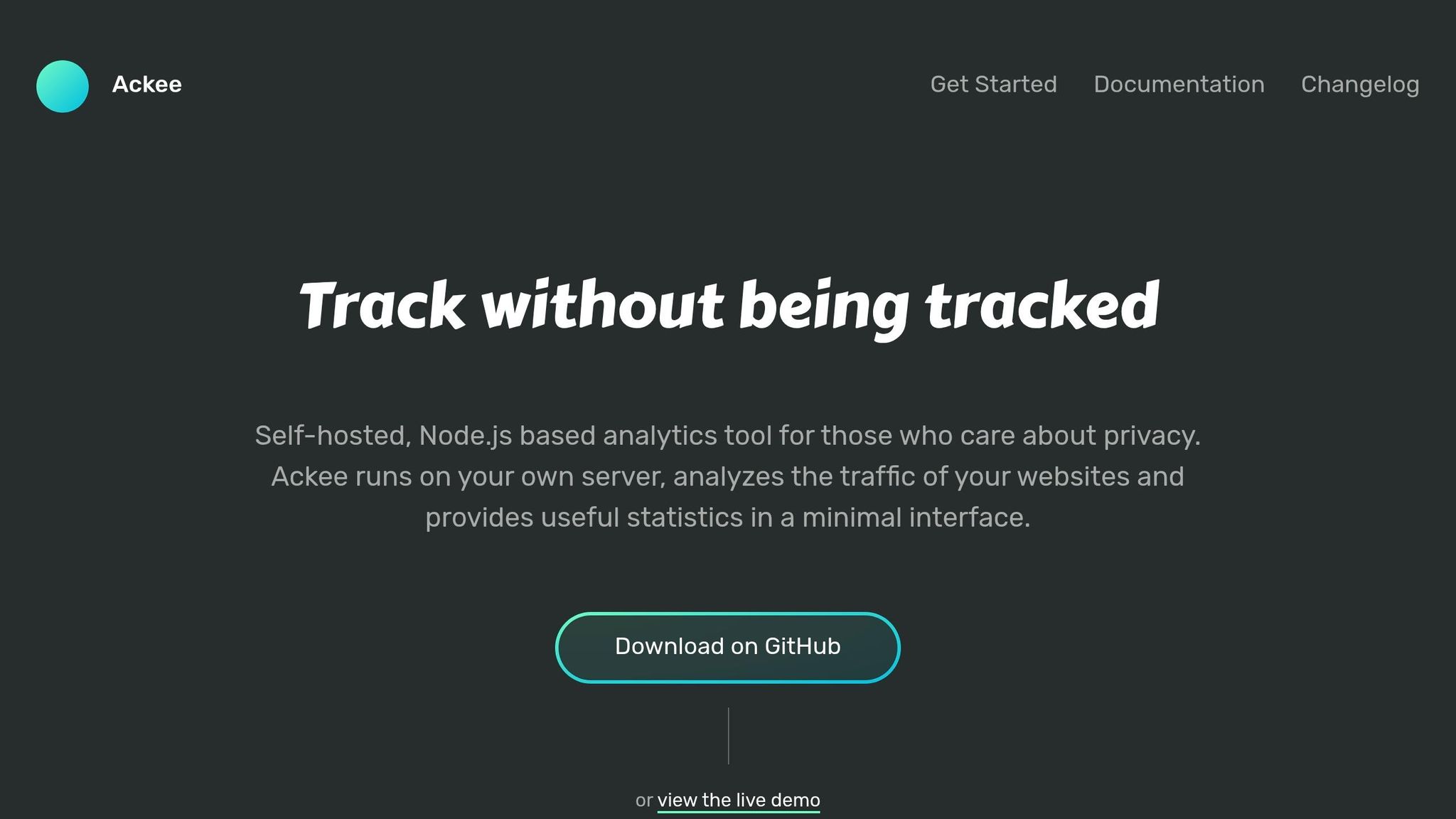
Ackee takes a straightforward approach to web analytics, prioritizing simplicity and essential metrics. With over 4,600 stars on GitHub as of April 2026 and contributions from 45 developers, it has gained a solid reputation among users. Project lead electerious describes it as:
"It's the right tool for everyone who doesn't need a full-featured marketing analytics platform like Google Analytics or Matomo".
Ackee is designed for users who value simplicity without sacrificing functionality. Here's a closer look at its licensing, deployment options, core features, and privacy focus.
License Type
Ackee operates under the MIT License, making it completely open-source and free to use. There are no hidden costs, licensing fees, or restrictions on modifying or distributing the software. Unlike some analytics tools, Ackee doesn't offer a managed cloud service; it's strictly built for self-hosting. The project thrives on community support and donations instead of adopting a commercial model.
Self-Hosting Support
To run Ackee, you'll need a Node.js environment and a MongoDB database. The simplest way to set it up is through Docker Compose, but manual installation or deployment on platforms like Heroku, Netlify, Vercel, and Railway are also supported [46, 47]. For smaller websites, MongoDB Atlas's free 512 MB tier can help keep infrastructure costs low. The tracking script is highly efficient, weighing just about 6 KB (gzipped), and the interface is powered by a GraphQL API [46, 47, 48].
Primary Focus
Ackee's main goal is to provide minimalist web analytics. It tracks only essential, anonymous metrics such as referrers, session duration, language, screen size, and browser type. Advanced features like funnels, heatmaps, or session replays are intentionally excluded to maintain simplicity. Users often describe the interface as "beautiful", "minimal", and "blazing fast." For those who need more detailed insights, a "detailed" mode is available [46, 47].
Privacy Features
Ackee places a strong emphasis on privacy. By operating without cookies, it eliminates the need for GDPR consent banners [46, 47, 48]. The official website highlights this commitment:
"Your data should be in your hands. Ackee is 100% open-source and self-hosted, to ensure complete transparency".
To further protect user data, Ackee uses a multi-step anonymization process with daily-rotating salt hashes, preventing long-term tracking. Since all data is stored on your server, you have full control over its location and compliance requirements [46, 48].
7. Pirsch
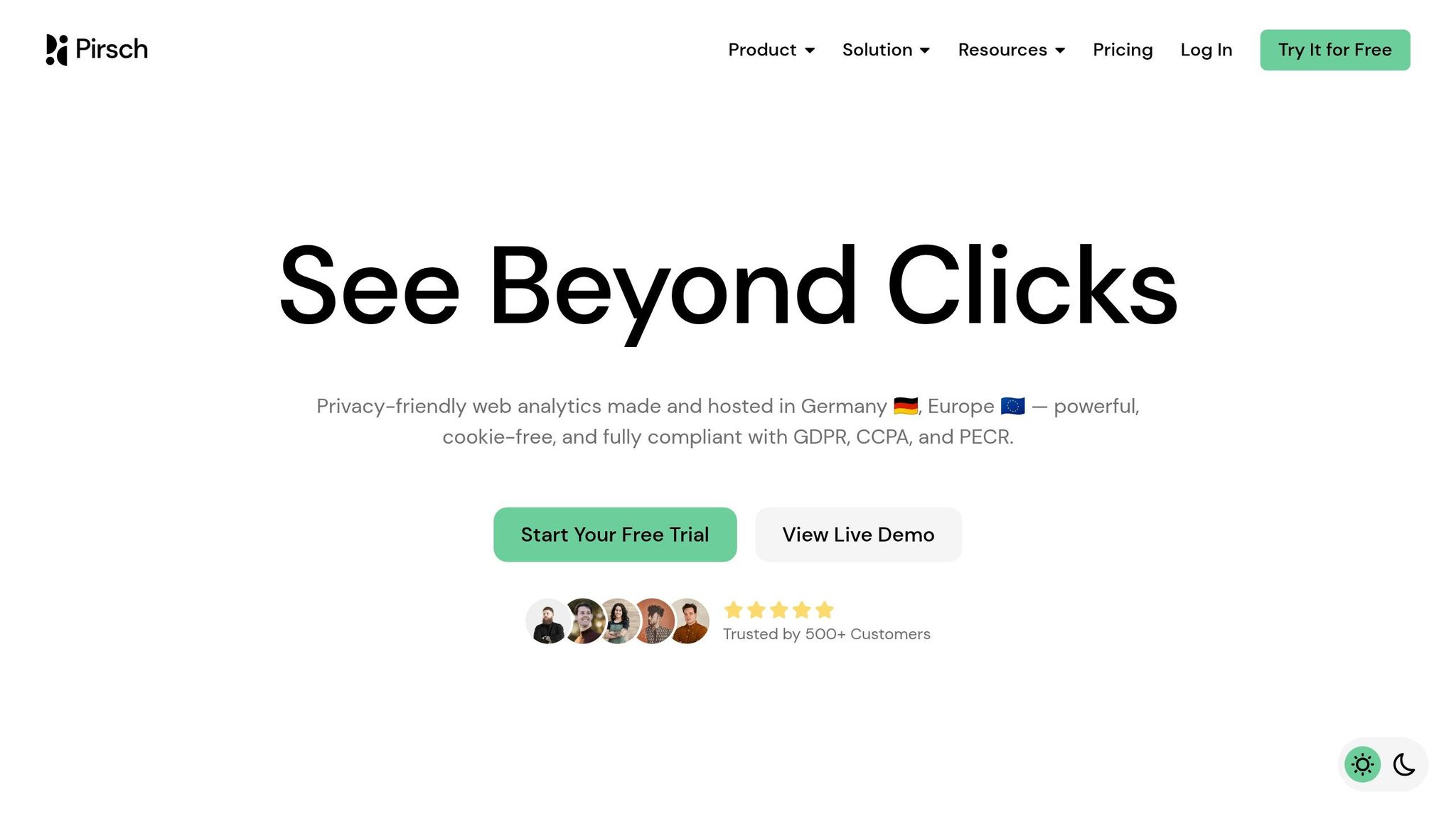
Pirsch is a privacy-focused analytics platform with over 500 customers as of April 2026. Hosted on German-owned servers at Hetzner in Nuremberg and Falkenstein, Pirsch prioritizes privacy and data control by adhering to European privacy laws. Its operations are fully transparent, with each release reflecting its commitment to these principles.
License Type
Pirsch's open-source core operates under the GNU AGPLv3 license. This allows businesses to review its data handling processes and verify its privacy measures.
Self-Hosting Support
Pirsch's core is developed in Go and relies on ClickHouse for its database. While the source code is publicly accessible on GitHub, production-level self-hosting typically requires an Enterprise license. For smaller-scale setups, developers can self-host a proxy (available in PHP and Go) to manage tracking requests. This proxy helps bypass ad blockers while maintaining first-party request status, making integration easier. The Enterprise plan also includes on-premise support, single sign-on via SAML, and dedicated assistance.
Primary Focus
Pirsch is designed as a privacy-conscious web analytics tool, with a strong focus on server-side integration. The Standard plan includes features like advanced filters, custom event tracking, and Google Search Console integration. The Plus plan expands functionality with tools like funnels, A/B testing, and segmentation. It’s available as a server-side solution for Go developers and also supports frontend integration. All plans come with a 30-day free trial, no credit card required.
Privacy Features
Pirsch operates without cookies, relying on a visitor fingerprint generated from a hash of the IP address, User-Agent, date, and a salt - without storing actual IP addresses. Session IDs are set to expire after 24 hours, preventing long-term profiling. Each domain receives a unique salt to block cross-site tracking. The platform provides unsampled, GDPR-compliant tracking and complies with GDPR, CCPA, PECR, and Schrems II regulations. Businesses handling EU citizens' data can also access a formal Data Processing Agreement.
8. Swetrix
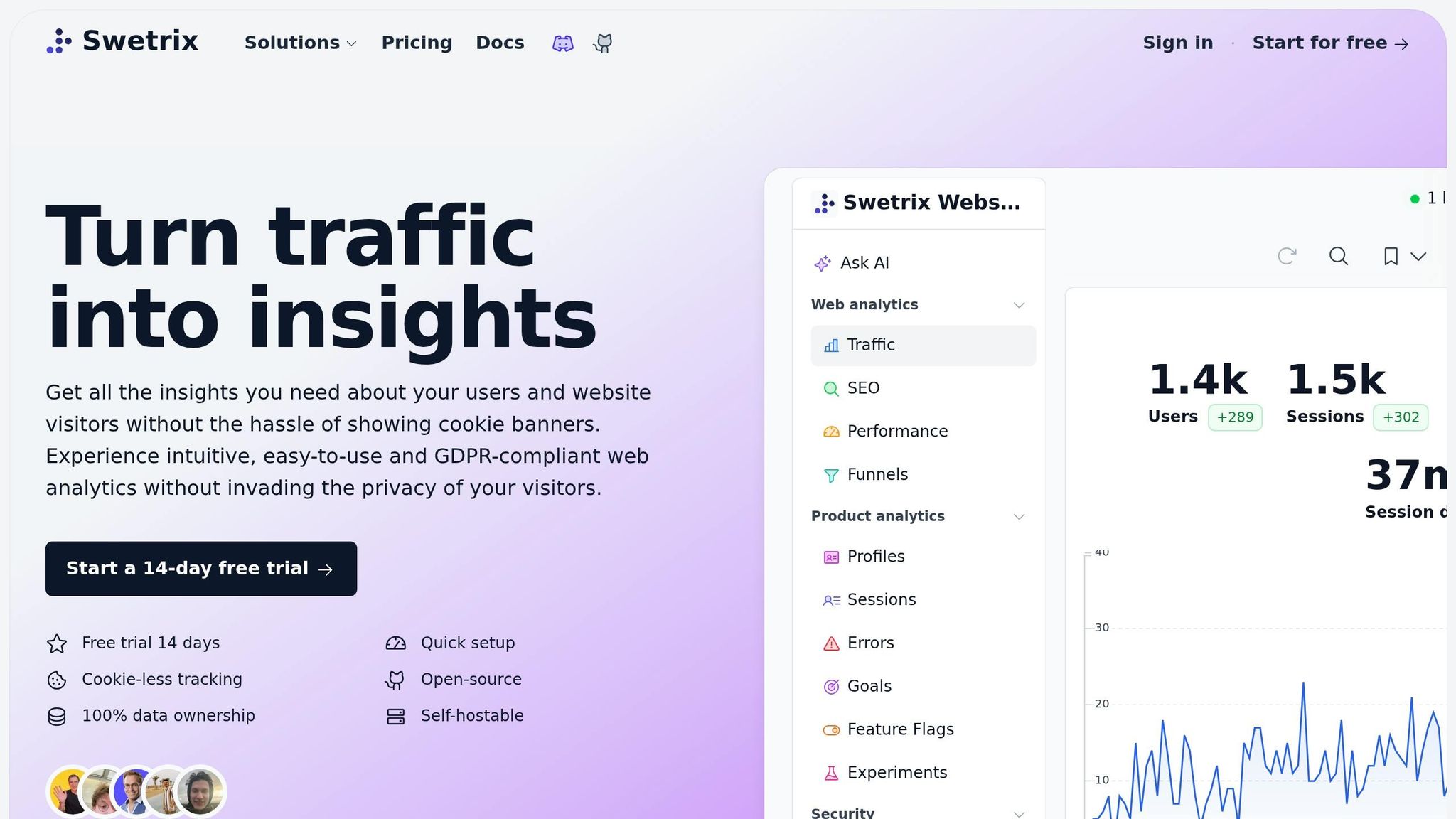
Swetrix is a privacy-focused platform combining web traffic analytics, performance monitoring, and error tracking. By April 2026, enterprise users on higher-tier plans have tracked over 20 million events while maintaining strict data anonymization practices. Its tracking script is lightweight, coming in at under 5 KB.
License Type
The Swetrix Community Edition operates under the GNU AGPLv3 license [59,60]. This license ensures that any changes made to the code for network-based services are shared back with the community. Additionally, the tracking script itself is distributed under the MIT license.
Self-Hosting Support
Swetrix provides a Community Edition designed for self-hosting through Docker. To set it up, you'll need MySQL, ClickHouse, and Redis. The backend is built with Nest.js and TypeORM, while the frontend uses React Router and Tailwind CSS. Setup involves cloning the repository, installing Docker dependencies, configuring environment variables (like BASE_URL), and running docker compose up -d. However, the self-hosted version does not include features exclusive to the cloud version, such as email reports, advanced revenue tracking, or the "Ask AI" assistant. This self-hosting option emphasizes Swetrix's focus on data privacy.
Primary Focus
Swetrix is an all-in-one analytics platform, offering tools for web analytics, real-user performance monitoring (RUM), and JavaScript error tracking [59,64]. These features help developers debug front-end issues and evaluate traffic metrics efficiently [64,66]. Additionally, Swetrix supports public dashboards, making it easier for open-source projects to share their growth metrics transparently with their communities.
Privacy Features
Staying true to its privacy-first philosophy, Swetrix avoids using cookies, eliminating the need for consent banners and preventing cross-site tracking [62,63]. All data is anonymized at the edge, ensuring no Personally Identifiable Information (PII) is collected or stored [59,63]. The platform complies with GDPR, CCPA, and PECR regulations [62,65], with data hosted on Hetzner servers in Germany to guarantee EU data residency. For organizations that require complete control over their data, the self-hosted Community Edition ensures all traffic data remains entirely within their infrastructure [62,63,68]. Pricing for the cloud-hosted version starts at $19.00 per month for up to 100,000 events [62,64].
9. Shynet
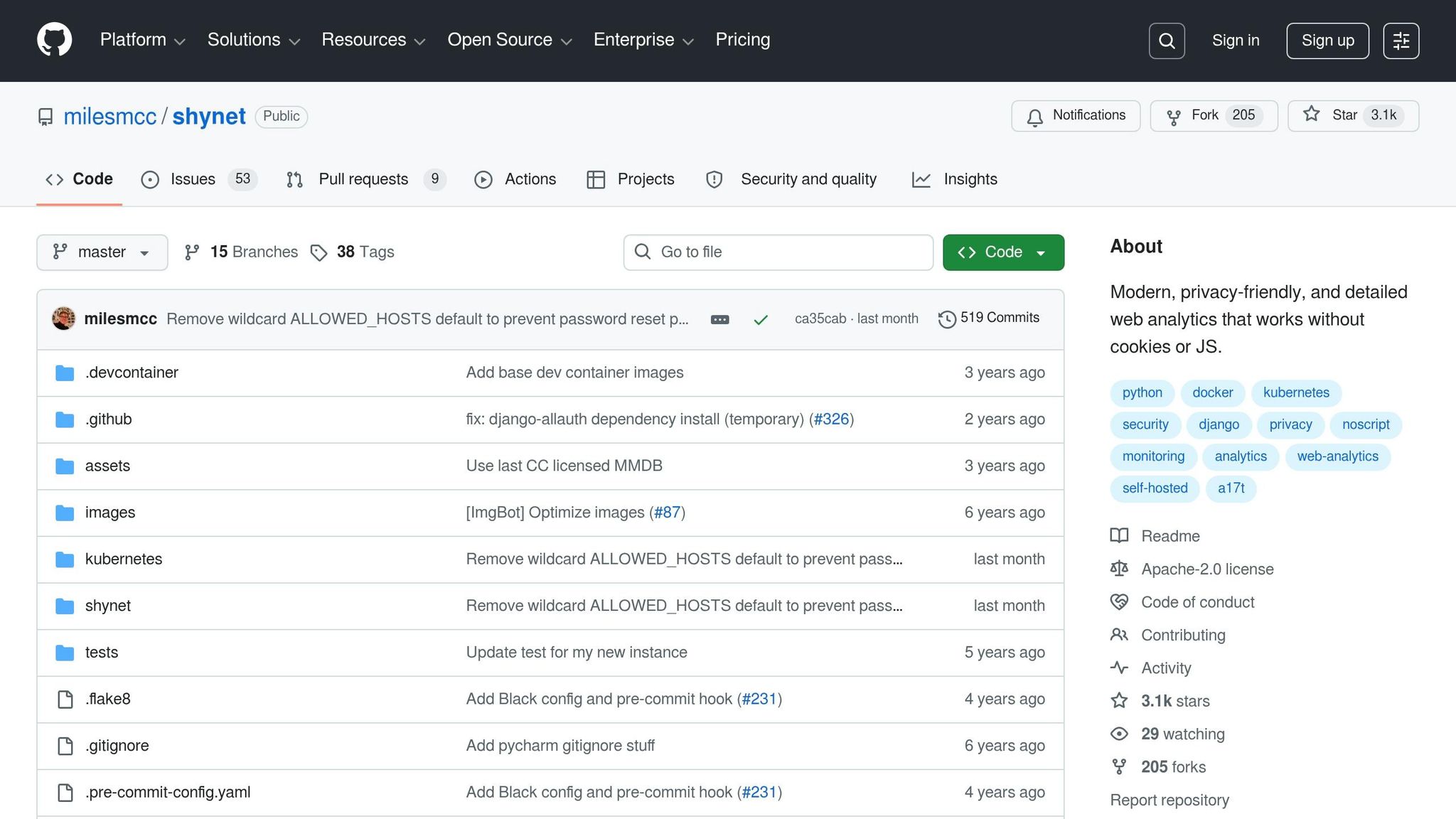
Shynet is a web analytics tool designed with privacy at its core, developed by Miles McCain. Its name cleverly combines "Skynet" and "shy", reflecting its focus on delivering analytics while respecting user privacy. By early 2026, Shynet had garnered over 3,100 stars and 205 forks on GitHub, signaling its appeal to developers looking for a Google Analytics alternative.
License Type
Shynet operates under the Apache License, version 2.0. This open-source license allows users to self-host the software, ensuring complete ownership of their data. It also ensures that any contributions to the project are shared under the same terms. This setup provides flexibility while prioritizing user control.
Self-Hosting Support
Shynet offers versatile deployment options, including Docker, docker-compose, Heroku, and Kubernetes. For smaller projects or personal use, it can run as a single Docker container on a modest VPS. For larger setups, it scales seamlessly to Kubernetes clusters with Redis caching and dedicated backend workers for database tasks. Built using the Django framework, Shynet is primarily written in Python (62.8%) and HTML (33.2%). However, deploying it requires a moderate level of technical expertise.
Primary Focus
Shynet delivers modern, privacy-conscious web analytics without relying on cookies or JavaScript. Its lightweight tracking script is under 1 KB, and when JavaScript is unavailable, it defaults to a 1x1 transparent tracking pixel. The tool gathers essential metrics - like hits, sessions, page load time, and referrers - without collecting unnecessary data. This minimalist approach aligns perfectly with its privacy-first philosophy.
Privacy Features
Shynet avoids cookies entirely, eliminating the need for those pesky consent banners. It respects "Do Not Track" (DNT) settings by default and keeps all data on your own infrastructure, giving users full control over their analytics. For geolocation, Shynet uses IP-based insights but avoids storing personally identifiable information, limiting data collection to what’s necessary for general location tracking. As Miles McCain explains:
"You host it yourself, so the data is yours. It works without cookies, so you don't need any intrusive cookie notices".
While Shynet is free to use thanks to its open-source license, users are responsible for their server costs and maintenance.
10. Countly
Countly is an analytics platform designed with privacy in mind, tailored for mobile, web, desktop, and IoT devices. Over the past 13 years, it has grown into a versatile tool for tracking customer behavior across platforms. By April 2026, it had earned over 5,800 stars and 981 forks on GitHub, showcasing its active developer community.
License Type
Countly follows an "Open Core" model. The free version, Countly Lite, is licensed under the GNU Affero General Public License v3.0 (AGPL-3.0). This license ensures that any changes made to the software - whether for personal use or as a service - must be shared with the community. While the core features are fully open source on GitHub, advanced functionalities like heatmaps and A/B testing are reserved for the paid Enterprise edition.
Self-Hosting Support
Countly offers flexible self-hosting options for both its free Lite version and the paid Enterprise version. Installation is straightforward, with a one-line script available for Ubuntu, CentOS, or RHEL:
wget -qO- https://c.ly/install | bash
The platform also supports deployment through Docker and Vagrant. Built using MongoDB and Node.js, Countly requires a fresh Linux server with open ports 80 and 443. While setup is user-friendly, managing the infrastructure demands a solid understanding of Linux server administration. These deployment options pair well with Countly's analytics capabilities. They also complement other advanced web building tools used to create modern, responsive sites.
Primary Focus
Countly is built to provide product and behavioral analytics across various platforms, from mobile apps to connected devices. Unlike tools that prioritize marketing metrics, Countly focuses on delivering a comprehensive picture of customer journeys with real-time insights. CEO Onur Soner describes their mission:
"Our vision from inception was to create a powerful analytics platform that respects data privacy".
Its plugin-based architecture makes it highly customizable without locking users into a specific vendor. The platform's tracking script is also lightweight, at just 3.5 KB.
Privacy Features
Countly prioritizes data protection with a suite of compliance tools and offline data handling. Its Compliance Hub simplifies consent collection and manages data subject requests, ensuring adherence to regulations like GDPR, HIPAA, CCPA, and COPPA. Features such as cookieless tracking, data anonymization, and on-premises deployment ensure complete data control. Adeel Bhatti, Manager of Business Operations, highlights this integration:
"What I love the most about Countly is the integration of data - the way the information from one feature ties into another and pulls from another. This gives us a complete, comprehensive view of customer behavior".
Organizations retain 100% ownership of their data, and the platform supports offline environments by queuing data through its SDKs until an internet connection is restored.
11. Snowplow
Snowplow serves as Customer Data Infrastructure (CDI) rather than a standard analytics tool. Its main purpose is to convert raw behavioral data into event streams that fuel AI-driven tools, real-time personalization, and fraud detection systems. With the capacity to handle billions of events daily, Snowplow offers over 20 SDKs for collecting data from web, mobile, and server-side sources.
License Type
As of January 8, 2024, Snowplow transitioned its core pipeline licensing to the Snowplow Limited Use License Agreement (SLULA). While some components remain under the Apache-2.0 license, production use and competitive applications now require direct licensing discussions. The source code is still viewable on GitHub, but security patches are no longer provided for versions released before the January 2024 licensing update. For production use, organizations must negotiate terms directly with Snowplow.
Self-Hosting Support
Snowplow’s Community Edition allows self-hosting for testing and evaluation purposes at no cost. Deployment relies on Infrastructure as Code (IaC), using Terraform modules compatible with AWS, GCP, and Azure. The platform’s Iglu Server facilitates managing custom event schemas. This setup enables organizations to securely deliver event-level data to their own warehouse, lake, or stream, paving the way for advanced data processing.
Primary Focus
Snowplow’s flexible deployment capabilities position it as essential infrastructure for advanced analytics and machine learning. Anup Purewal, Chief Data Officer at FindMyPast, highlighted its impact:
"Snowplow Signals provides our product and engineering teams with the real-time customer intelligence infrastructure they need to build adaptive, AI-powered experiences..."
The platform offers over 15 data enrichments to improve behavioral data quality and supports real-time processing via cloud-native streaming services like Kinesis, Pub/Sub, or EventHubs.
Privacy Features
Snowplow uses more than 35 first-party trackers and webhooks, eliminating the need for third-party cookies while ensuring compliance with GDPR and CCPA. Organizations can deploy Snowplow in their own cloud environments, ensuring that sensitive data remains under their control. The platform also includes advanced governance tools for monitoring data quality and supports cookieless tracking with flexible data anonymization during real-time enrichments. Darren Haken, Head of Engineering at Burberry, shared his perspective:
"Access to first-party data has made our data engineers have more empathy for our marketers and our marketers are now more willing to provide insight into the campaigns they are running".
12. KNIME
KNIME takes a different path compared to standard web and product analytics tools. It’s a low-code/no-code platform designed for data science, machine learning, and ETL workflows. While other tools zero in on web and product metrics, KNIME provides a versatile solution for more complex tasks like blending data from multiple sources, creating predictive models, and automating intricate analytics processes - all through an intuitive drag-and-drop interface. This makes it a standout choice in 2026 for organizations looking to combine data science capabilities with on-premises analytics.
License Type
KNIME Analytics Platform operates under GPLv3, with a special exception allowing commercial vendors to develop proprietary extensions while keeping the core platform fully open. Unlike many "open-core" models that limit features in community editions, KNIME offers the entire platform for free, without restrictions on data size or processing power. Most of KNIME’s revenue - over 90% - comes from commercial software licenses for their Business Hub, a portion of which is reinvested in further open-source development.
Self-Hosting Support
KNIME’s desktop application can be downloaded to process data locally on any operating system or integrated with existing distributed big data setups. The platform supports over 300 connectors for various data sources, ranging from local files to cloud data warehouses. It also integrates with Python, R, and JavaScript for custom scripting. With a community of more than 100,000 users and access to 14,000+ pre-built workflows on the KNIME Community Hub, organizations can build analytics solutions without exposing sensitive data to external servers.
Primary Focus
KNIME stands apart from tools focused purely on web analytics by enabling advanced data integration and machine learning workflows. Its modular drag-and-drop interface simplifies building data pipelines. Santiago C, a professional in the retail industry, shared:
"The only tool that we were able to implement for non-technical user adoption. The easy drag and drop flow interface enables our coworkers to develop their own solutions".
The 2026 version also introduces a genAI assistant that helps users create analyses, visualizations, and scripts using natural language prompts.
Privacy Features
KNIME processes data locally or within an organization’s own infrastructure, giving businesses full control over sensitive information. This self-hosted setup ensures compliance with regulations like GDPR and CCPA without depending on third-party cloud services. Sasha R, a Product Lead, highlighted:
"KNIME allowed me to pull data from large Google sheets and manipulate them in an accessible way. The visual representation of each node makes it really easy to use and understand even for people without a background in data analytics".
Tool Comparison Table
The table below provides an overview of 12 analytics tools, detailing their license types, self-hosting options, primary focus areas, and privacy-related features.
| Tool | License | Self-Hosting | Primary Focus | Privacy Features |
|---|---|---|---|---|
| OpenPanel | AGPL-3.0 | Self-hosted at no extra cost (Docker) | Web + Product Analytics | Cookieless, GDPR/CCPA compliant |
| PostHog | MIT | Self-hosted at no extra cost (Docker/K8s) | Product + Web Analytics | Session replay, feature flags (consent-based) |
| Plausible | AGPL-3.0 | Self-hosted at no extra cost (Docker) | Web Analytics | Lightweight (~1 KB script), no cookies |
| Matomo | GPL-3.0 | Self-hosted at no extra cost (PHP/MySQL) | Web Analytics | 100% data ownership, GDPR Manager |
| Umami | MIT | Self-hosted at no extra cost (Docker) | Web Analytics | Lightweight (~2 KB script), cookieless |
| Ackee | MIT | Self-hosted at no extra cost (Node.js/MongoDB) | Minimalist Web Analytics | Anonymized tracking, no cookies |
| Pirsch | AGPL-3.0 | Enterprise license required for self-hosting | Web Analytics | Server-side tracking, works with ad blockers |
| Swetrix | AGPL-3.0 | Self-hosted at no extra cost | Web + Performance Monitoring | Lightweight (~3.5 KB script), cookieless |
| Shynet | Open Source | Self-hosted at no extra cost | Web Analytics | Cookie-free, privacy-friendly |
| Countly | AGPL-3.0 | Self-hosted at no extra cost (Lite version) | Product Analytics | GDPR/CCPA compliant |
| Snowplow | Custom (OSS components) | Self-hosted at no extra cost | Behavioral Data Platform | Data sovereignty, full schema control |
| KNIME | GPLv3 | Self-hosted at no extra cost (Desktop/On-Premises) | Data Science + ETL | Local processing, full data control |
This table simplifies comparing the tools by highlighting their most critical aspects.
Licensing and Self-Hosting
Licenses determine how you can use and adapt these tools. For example, MIT licenses allow extensive flexibility for modifications, while AGPL-3.0 and GPL licenses require sharing any network-based changes.
Self-hosting requirements vary depending on the tool. For organizations prioritizing data residency - whether for GDPR or HIPAA compliance - self-hosting ensures full control over data without involving third parties.
Privacy Features and Cookieless Tracking
Privacy compliance is a major focus for many tools. Cookieless tracking, adopted by platforms like OpenPanel, Plausible, Umami, Ackee, Pirsch, Swetrix, and Shynet, eliminates the need for intrusive consent banners while remaining GDPR and CCPA compliant.
PostHog, on the other hand, currently requires user consent for data collection but plans to introduce a cookieless option soon. Tools such as Plausible and Umami stand out for their lightweight tracking scripts, which not only respect privacy but also improve performance.
Conclusion
Open-source analytics tools bring distinct advantages that proprietary platforms simply can't compete with: full data ownership, freedom from vendor lock-in, and built-in privacy compliance. Plus, self-hosting options allow you to save on costs while maintaining complete control over your setup.
The right tool for you depends on your specific analytics needs. For straightforward traffic stats and referral tracking, Plausible or Umami are excellent lightweight options that deliver cookieless tracking without bogging down your site. If you're a product team focused on user journeys, funnels, or retention, consider OpenPanel or PostHog for their advanced feature sets. Meanwhile, enterprises looking for a robust alternative to Google Analytics should explore Matomo, trusted by governments and large organizations for its strong compliance record.
While self-hosting ensures total control over your data, it does require technical expertise. If that's a challenge, many tools also offer cloud-hosted solutions to simplify deployment for teams without DevOps resources.
In the bigger picture, open-source analytics tools offer more than just technical flexibility. They empower businesses to create tailored platforms that align with their unique needs. As The Cake Team puts it:
"Choosing an open-source tool is a strategic move that gives you more control over your data and your tech stack. It's about building an analytics platform that truly fits your business, rather than fitting your business into a pre-packaged box".
Select a solution that aligns with your team's capabilities and priorities, and you'll have an analytics foundation that grows with your privacy and compliance demands.
FAQs
Which tool is best for simple web stats vs product analytics?
For straightforward web statistics, Plausible is a solid choice. It’s lightweight, prioritizes privacy, and tracks essential metrics like pageviews and referrers - all without relying on cookies. If you need product-focused analytics, OpenPanel and PostHog are better suited. OpenPanel is a privacy-conscious, self-hosted option, while PostHog includes advanced features like funnels, retention analysis, and experiments. Choose Plausible for basic stats, and turn to OpenPanel or PostHog for more in-depth product insights.
Do I still need a cookie consent banner with cookieless tracking?
Yes, even as cookieless tracking becomes more prevalent in 2026, you might not need a cookie consent banner if you're using tools that focus on privacy and follow the rules. Many cookieless analytics platforms work without relying on cookies, which can eliminate the need for consent while still adhering to privacy laws. However, it's crucial to double-check your tool's compliance to make sure it meets all legal standards.
What are the biggest self-hosting requirements to plan for?
When you decide to self-host analytics tools, there are a few key things to get right from the start. First, you'll need to set up the infrastructure - this includes servers, storage, and networking. Depending on the tool you're using, you might also need to manage environments like Docker or a combination of PHP and MySQL.
Security is a top priority. Make sure to configure firewalls, enable SSL for encrypted connections, and set up strict access controls. If the tool relies on databases like MySQL or MongoDB, you'll need solid database management skills to keep things running smoothly.
It's also important to think ahead about scalability - your system should be able to handle growth as your data needs expand. And don't forget about ongoing tasks like applying updates and performing maintenance. These steps are essential to keep your systems secure and compatible with the latest standards.